

Every believer, at some point, reaches a moment where guilt feels heavier than grace. Maybe you said something you regret, broke a promise to yourself, or drifted away from God without even noticing. In those quiet, uncomfortable moments, prayer becomes the bridge that carries us back to His presence.
Prayers for forgiveness of sins are not about reciting perfect words. They are about coming to God honestly, laying down what weighs on your heart, and trusting that His mercy is bigger than your mistakes. Scripture reminds us again and again that God does not turn away the repentant heart He runs toward it.
This guide brings together more than 80 heartfelt prayers, dozens of Bible verses, real biblical examples of forgiveness, and practical steps to help you walk in freedom rather than guilt. Whether you’re praying for the first time in years or simply need words for today, you’ll find something here to help you reconnect with God’s compassion.
You’ll also learn how to recognize true repentance, what obstacles keep people from fully receiving forgiveness, and which daily habits help believers stay close to God long after the prayer is prayed. Forgiveness is not a one-time transaction — it’s an ongoing relationship built on honesty, humility, and trust in God’s unchanging love. By the end of this article, you’ll have a practical, Scripture-based toolkit you can return to whenever guilt tries to convince you that grace has run out.
What Is Prayers for Forgiveness of Sins According to the Bible?
A prayer for forgiveness of sins is a heartfelt conversation with God in which a person acknowledges wrongdoing, expresses genuine sorrow, and asks for mercy through Jesus Christ. It is not a magic formula or a checklist it’s an honest exchange between a repentant heart and a loving Father.
According to Scripture, forgiveness of sins is only possible because of the sacrifice of Jesus Christ. As 1 John 1:9 states, “If we confess our sins, he is faithful and just to forgive us our sins and to cleanse us from all unrighteousness.” This verse captures the essence of biblical forgiveness: confession leads to cleansing, not condemnation.
Praying for forgiveness involves three core elements:
- Confession – admitting what was done wrong, without excuses.
- Repentance – a genuine change of heart and direction.
- Faith – trusting that God’s grace, not our effort, secures forgiveness.
This kind of prayer is deeply personal, yet it follows a pattern found throughout the Bible, from David’s psalms of repentance to Jesus’s own teaching on prayer in the Sermon on the Mount.
It’s important to understand that forgiveness in Scripture is never portrayed as something believers earn through good deeds, penance, or emotional intensity. Ephesians 2:8-9 makes clear that salvation — and by extension, forgiveness — comes “by grace… through faith,” not by works. This means a prayer for forgiveness isn’t about convincing a reluctant God to change His mind; it’s about aligning your heart with a truth that’s already been made available through the cross. The moment a person confesses with genuine faith, forgiveness isn’t earned in that instant — it’s received.
Why Is Asking God for Forgiveness Important?

Asking God for forgiveness isn’t just a religious formality — it’s essential to spiritual health and a close relationship with Him. Sin creates distance between us and God, and unconfessed guilt can quietly erode peace, confidence, and joy.
Here’s why this practice matters so deeply:
- It restores fellowship with God. Sin interrupts intimacy with the Father, and confession opens the door back to closeness.
- It aligns your heart with truth. Hiding sin breeds denial; confession brings honesty and clarity.
- It releases guilt and shame. Carrying unconfessed sin often leads to emotional and even physical weariness.
- It reflects trust in God’s character. Approaching Him for forgiveness shows you believe He is merciful, not distant or vengeful.
- It shapes how you treat others. Experiencing forgiveness makes it easier to extend forgiveness to those who’ve hurt you.
Psalm 32:3-4 describes what happens when sin goes unconfessed: strength dries up, and the soul feels weighed down. But verse 5 offers the remedy — confession brings immediate relief: “I acknowledged my sin to you… and you forgave the guilt of my sin.”
Beyond the personal benefits, asking for forgiveness is also an act of worship. It acknowledges God’s holiness and His right to define right from wrong, rather than allowing our own standards to dictate morality. It also reflects dependence — a recognition that we cannot live rightly by our own strength alone. In this sense, prayers for forgiveness are less about damage control and more about ongoing surrender, keeping the relationship between believer and Creator honest, humble, and alive.
How to Pray for Forgiveness of Sins?
Praying for forgiveness doesn’t require special language or theological training. It requires honesty and humility. Below are five essential steps that shape a sincere prayer of repentance.
Confess Your Sins Honestly
Start by naming your sin specifically, rather than offering a vague apology. God already knows what you’ve done — confession isn’t for His information, it’s for your transformation. Being specific helps you take ownership instead of glossing over what happened. Instead of praying “forgive me for everything,” try naming the actual thought, word, or action. Specificity keeps prayer honest and prevents confession from becoming a routine habit emptied of meaning.
Repent with a Sincere Heart
Repentance means more than feeling sorry; it means a genuine change of direction. Godly sorrow, as described in 2 Corinthians 7:10, leads to life change, while worldly regret often just leads to more guilt without transformation. Ask God not only to forgive the act but to change the desire behind it — this is what separates temporary remorse from lasting repentance.
Believe in God’s Mercy
Approach God with confidence, not fear. Hebrews 4:16 invites believers to come boldly to the throne of grace to receive mercy. Doubting His willingness to forgive contradicts what Scripture consistently promises. Many believers confess sin correctly but then walk away still convinced they’re unforgiven — this step is about actively choosing to believe God’s Word over your own feelings of unworthiness.
Turn Away from Sin
True forgiveness invites a new direction. This doesn’t mean instant perfection, but it does mean a real commitment to walk away from the sin you’ve confessed, relying on God’s strength rather than willpower alone. This might involve removing certain influences, seeking accountability, or asking the Holy Spirit for daily strength to resist temptation in that specific area.
Walk in Faith and Obedience
After confession, live as someone who has been forgiven. Obedience isn’t what earns forgiveness — grace does that — but it is the natural response of a heart that has truly received it. As you grow in faith, obedience becomes less about rule-following and more about gratitude, a natural overflow of a heart that has experienced undeserved mercy.
What Does the Bible Say About Forgiveness of Sins?
The Bible presents forgiveness as central to God’s character and His relationship with humanity. From Genesis to Revelation, Scripture reveals a God who is “merciful and gracious, slow to anger, and abounding in steadfast love” (Psalm 103:8).
Forgiveness isn’t a New Testament concept alone — it runs through the entire biblical narrative. The sacrificial system in the Old Testament pointed toward the ultimate sacrifice of Jesus, who “was delivered up for our trespasses” (Romans 4:25). Through His death and resurrection, forgiveness became available once and for all to anyone who repents and believes.
Under the Old Covenant, forgiveness required repeated animal sacrifices offered by priests on behalf of the people — a system that, while effective, had to be renewed continually. Hebrews 10:10-12 explains that Jesus’s single sacrifice fulfilled and completed what those offerings pointed toward, making Him both the perfect priest and the perfect offering. This shift is central to understanding why New Testament forgiveness feels both immediate and permanent: it isn’t based on a repeated ritual but on a finished work.
God’s Promises to Forgive Those Who Repent
Scripture is filled with promises assuring believers that sincere repentance leads to real forgiveness:
| Promise | Bible Verse |
| Sins are removed as far as east is from west | Psalm 103:12 |
| God is faithful to forgive confessed sin | 1 John 1:9 |
| Sins are remembered no more | Hebrews 8:12 |
| Scarlet sins become white as snow | Isaiah 1:18 |
| There is no condemnation in Christ | Romans 8:1 |
| Times of refreshing follow repentance | Acts 3:19 |
These promises aren’t conditional on perfection — they are conditional on a sincere, repentant heart turning to God.
30 Powerful Prayers for Forgiveness of Sins with Bible Verses
Below are 30 prayers you can use in your personal devotion time. Each one pairs a short prayer with a relevant Scripture to anchor your heart in God’s Word.
- For a Clean Heart – “Create in me a clean heart, O God” (Psalm 51:10). Father, wash away my sin and give me a heart that seeks You above all else. Amen.
- For Honest Confession – “If we confess our sins…” (1 John 1:9). Lord, I confess what I’ve hidden. Cleanse me and set me free from shame. Amen.
- For Godly Sorrow – “Godly sorrow brings repentance” (2 Corinthians 7:10). Father, let my sorrow lead to real change, not just regret. Amen.
- For Release from Guilt – “There is no condemnation” (Romans 8:1). Jesus, help me release the guilt I keep carrying even after confessing. Amen.
- For a Renewed Spirit – “Renew a right spirit within me” (Psalm 51:10). Lord, restore joy and steadiness to my weary soul. Amen.
- For Mercy in Weakness – “Let us then approach the throne of grace” (Hebrews 4:16). Father, I come boldly, trusting Your mercy despite my failures. Amen.
- For Freedom from Habitual Sin – “Everyone who sins is a slave to sin” (John 8:34). Lord, break the chains of repeated sin in my life. Amen.
- For Peace After Wrongdoing – “Peace I leave with you” (John 14:27). Jesus, calm my anxious heart after I’ve fallen short. Amen.
- For Restoration of Relationship – “Return to me” (Zechariah 1:3). Father, draw me close again after I’ve drifted from You. Amen.
- For Strength to Repent – “Repentance and forgiveness of sins” (Luke 24:47). Lord, give me courage to turn fully away from sin. Amen.
- For a Humble Heart – “A broken and contrite heart” (Psalm 51:17). God, humble me so I can receive Your grace fully. Amen.
- For Forgiveness of Hidden Sins – “Cleanse me from hidden faults” (Psalm 19:12). Father, reveal what I haven’t noticed in myself and cleanse it. Amen.
- For Trust in God’s Mercy – “His mercies never come to an end” (Lamentations 3:22). Lord, help me trust Your mercy is greater than my failure. Amen.
- For Forgiveness of Anger – “Be angry and do not sin” (Ephesians 4:26). Father, forgive the anger I let control me. Teach me patience. Amen.
- For Forgiveness of Pride – “Pride goes before destruction” (Proverbs 16:18). Lord, humble my heart and remove selfish pride. Amen.
- For Forgiveness of Dishonesty – “Lying lips are an abomination” (Proverbs 12:22). Father, forgive my dishonesty and give me a truthful spirit. Amen.
- For Forgiveness of Jealousy – “Love does not envy” (1 Corinthians 13:4). Lord, uproot jealousy and replace it with contentment. Amen.
- For Forgiveness of Unforgiveness – “Forgive as the Lord forgave you” (Colossians 3:13). Father, forgive me for withholding forgiveness from others. Amen.
- For Forgiveness of Neglecting God – “Seek first the kingdom” (Matthew 6:33). Lord, forgive me for placing You last. Realign my priorities. Amen.
- For Forgiveness of Doubt – “Help my unbelief” (Mark 9:24). Father, forgive my doubt and strengthen my faith in You. Amen.
- For Forgiveness of Harsh Words – “The tongue has the power of life and death” (Proverbs 18:21). Lord, forgive my careless words and guard my mouth. Amen.
- For Forgiveness of Selfishness – “Value others above yourselves” (Philippians 2:3). Father, forgive my self-centeredness and grow compassion in me. Amen.
- For Freedom from Shame – “Those who look to him are radiant” (Psalm 34:5). Lord, lift the shame I carry and replace it with confidence in You. Amen.
- For Forgiveness of Broken Promises – “Let your yes be yes” (Matthew 5:37). Father, forgive me for breaking my word and help me be faithful. Amen.
- For a Fresh Start – “Old things have passed away” (2 Corinthians 5:17). Lord, thank You for making me new. Help me live like it. Amen.
- For Forgiveness Before Communion – “Examine yourselves” (1 Corinthians 11:28). Father, search my heart and cleanse me before I come to Your table. Amen.
- For Forgiveness of a Recurring Sin – “Seventy times seven” (Matthew 18:22). Lord, thank You for patience with my repeated struggles. Help me overcome. Amen.
- For Peace of Mind – “Cast all your anxiety on him” (1 Peter 5:7). Father, take the weight of my mistakes; give me rest. Amen.
- For Boldness to Confess to Others – “Confess your sins to each other” (James 5:16). Lord, give me courage to be honest with those I’ve wronged. Amen.
- For a Grateful Heart After Forgiveness – “Bless the Lord, who forgives all your sins” (Psalm 103:2-3). Father, thank You for grace I don’t deserve. Keep my heart grateful. Amen.
Powerful Bible Verses About Forgiveness of Sins
Scripture offers a rich foundation for understanding forgiveness. Below are key verses grouped by section of the Bible.
Old Testament Scriptures
- Psalm 103:12 – “As far as the east is from the west, so far has he removed our transgressions from us.”
- Isaiah 1:18 – “Though your sins are like scarlet, they shall be as white as snow.”
- Isaiah 43:25 – “I, even I, am he who blots out your transgressions.”
- Micah 7:18-19 – God delights in mercy and casts sins into the depths of the sea.
- Psalm 130:3-4 – “If you, Lord, kept a record of sins… but with you there is forgiveness.”
New Testament Scriptures
- 1 John 1:9 – Confession leads to faithful cleansing.
- Ephesians 1:7 – Redemption and forgiveness through Christ’s blood.
- Colossians 1:13-14 – Rescued from darkness into the kingdom of light.
- Acts 3:19 – Repentance brings “times of refreshing.”
- Romans 8:1 – No condemnation for those in Christ Jesus.
Psalms of Repentance and Mercy
- Psalm 51 – David’s prayer of repentance after his sin with Bathsheba.
- Psalm 32 – The blessing of confessed sin and forgiven guilt.
- Psalm 38 – A cry for mercy amid guilt and physical distress.
- Psalm 25:11 – “For your name’s sake, Lord, forgive my iniquity, though it is great.”
- Psalm 86:5 – “You, Lord, are forgiving and good, abounding in love.”
Examples of Forgiveness in the Bible
Scripture doesn’t just describe forgiveness theoretically — it shows it happening in real lives.
David’s Prayer of Repentance
After his affair with Bathsheba and the death of Uriah, David composed Psalm 51, one of the most honest prayers of repentance in Scripture. He didn’t excuse his sin; he owned it fully and asked God to create a clean heart within him. His example teaches that no failure is too great for God’s mercy when met with true humility.
The Prodigal Son
In Luke 15, Jesus tells the story of a son who wastes his inheritance and returns home in shame, only to be embraced by his father before he even finishes his apology. This parable reveals how eager God is to forgive — not reluctant, but running toward the repentant heart.
Peter’s Restoration
After denying Jesus three times, Peter was overwhelmed with grief. Yet in John 21, Jesus restores him personally, asking him three times if he loves Him — mirroring the three denials. This shows that failure doesn’t disqualify someone from God’s calling when repentance is genuine.
The Woman Caught in Adultery
In John 8, religious leaders bring a woman caught in sin, ready to condemn her. Jesus responds with both mercy and truth: “Neither do I condemn you… go now and leave your life of sin.” This encounter reflects forgiveness paired with a call to transformation.
The Thief on the Cross
Even in his final moments, a criminal crucified beside Jesus asked to be remembered in His kingdom. Jesus responded, “Today you will be with me in paradise” (Luke 23:43). This moment shows that forgiveness is available even at life’s very last breath, requiring only sincere faith.
Together, these five examples reveal a consistent pattern: forgiveness in Scripture is never limited by the severity of the sin, the timing of the confession, or the past reputation of the person asking. What matters is a genuine turning toward God, whether that turn happens through a psalm of anguish, a long walk home, a painful confrontation, or a single sentence spoken from a cross.
Benefits of Praying for Forgiveness
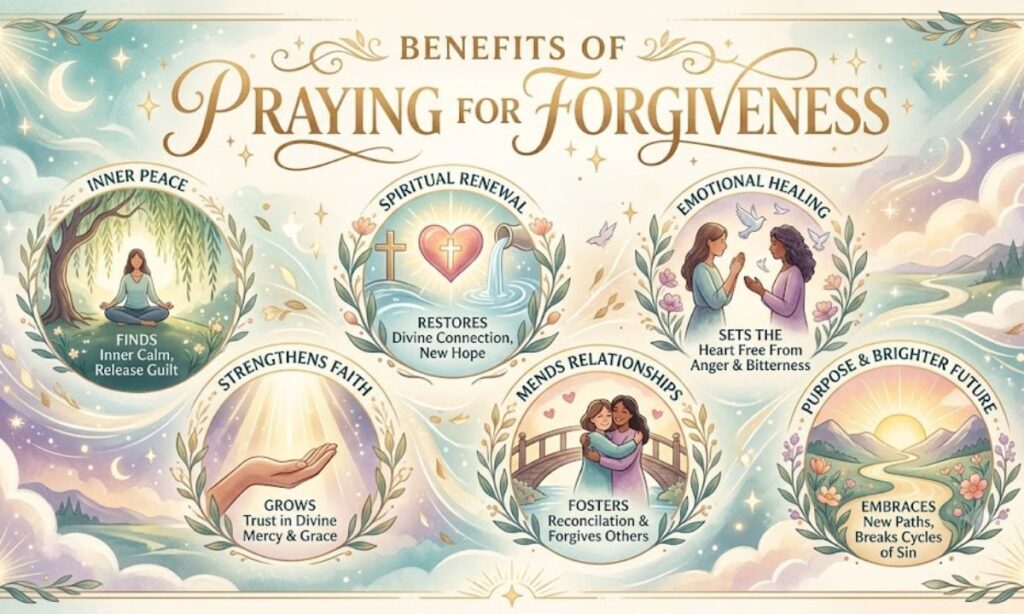
Confessing sin and receiving God’s forgiveness brings real, tangible change in a believer’s life.
Restores Your Relationship with God
Confession removes the barrier sin creates, allowing closeness with God to be renewed. Just as unresolved conflict distances two people, unconfessed sin creates emotional and spiritual distance in prayer, worship, and everyday awareness of God’s presence.
Brings Peace and Joy
Unconfessed sin often produces anxiety; forgiveness restores the “joy of your salvation” (Psalm 51:12). Many believers describe a tangible lightness after honest confession — a sense of relief that comes from no longer carrying a secret burden alone.
Removes Guilt and Shame
Instead of living under condemnation, believers can walk in the freedom described in Romans 8:1. Shame tends to isolate, while forgiveness invites believers back into community, worship, and confident relationship with God and others.
Renews Your Heart
Forgiveness isn’t just about erasing the past — it’s about God actively transforming the heart moving forward. Psalm 51:10 pairs confession with a request for a “clean heart” and a “right spirit,” showing that forgiveness is meant to change the future, not just settle the past.
Strengthens Your Faith
Experiencing God’s mercy firsthand deepens trust in His character and promises. Each time a believer prays sincerely and receives forgiveness, it builds a track record of trust that makes future obedience and faith easier to walk out.
Signs of True Repentance
Not every apology reflects real repentance. Scripture points to specific markers of a genuinely changed heart:
- Godly sorrow, not just fear of consequences (2 Corinthians 7:10)
- Willingness to make things right where possible
- A changed direction, not just changed words
- Humility instead of self-justification
- Consistent fruit over time, not a one-time emotional moment
The apostle Paul distinguishes between two kinds of sorrow in 2 Corinthians 7:10 — one that leads to death and one that leads to life. Worldly sorrow tends to focus on consequences (“I got caught” or “I feel embarrassed”), while godly sorrow focuses on the offense against God Himself. This distinction matters because it shapes whether repentance produces lasting change or simply a temporary pause before the same pattern repeats.
Common Obstacles to Receiving God’s Forgiveness
Many believers struggle to fully accept forgiveness even after confessing. Common obstacles include:
- Perfectionism – believing you must “earn” forgiveness through good behavior.
- Shame – feeling unworthy even after confession.
- Doubt – questioning whether God’s mercy really applies to a specific sin.
- Comparison – measuring your sin against others’ and feeling it’s “too much.”
- Unforgiveness toward yourself – holding on to guilt God has already released.
Overcoming these obstacles usually requires returning again and again to Scripture’s promises until they take root in the heart, not just the mind. It can also help to speak these truths out loud, write them down, or share them with a trusted friend or mentor — sometimes hearing forgiveness affirmed by another believer makes it easier to internalize than reading it silently alone.
Daily Habits That Help You Walk in God’s Forgiveness

Living in ongoing forgiveness isn’t a one-time event — it’s a daily rhythm.
Daily Prayer
Regular conversation with God keeps your heart sensitive to areas needing confession. A short daily check-in — even five minutes — prevents small compromises from growing into larger patterns of sin.
Bible Reading
Scripture renews the mind and reminds believers of God’s promises regarding mercy. Reading consistently, rather than only in moments of crisis, builds a foundation of truth that’s already in place when guilt or doubt strikes.
Worship
Worship shifts focus from personal failure to God’s greatness and grace. Singing or reflecting on who God is naturally reorients the heart away from self-focused shame and toward gratitude.
Confession
Ongoing, honest confession keeps the heart soft rather than hardened by hidden sin. Making confession a regular rhythm — rather than a last resort — helps believers stay spiritually current instead of carrying unaddressed guilt for weeks or months.
Accountability
Trusted relationships help believers stay honest and grow in consistency. James 5:16 specifically encourages confessing sins to one another, not just to God alone, because community provides both encouragement and gentle correction.
Forgiving Others
Jesus links receiving forgiveness with extending it (Matthew 6:14-15), making this a vital daily practice. Holding on to bitterness toward others often mirrors the same resistance to grace that keeps people from fully receiving God’s forgiveness for themselves.
Special Prayers for Different Situations
Different seasons call for different kinds of prayers. Here are a few tailored examples:
- For Forgiveness After a Big Mistake: “Lord, I’ve failed in a way I never expected. Please forgive me, restore what’s broken, and help me rebuild with wisdom. Amen.”
- For a Marriage Struggling with Trust: “Father, forgive the ways I’ve hurt my spouse. Heal our relationship and help us extend the grace You’ve given us. Amen.”
- For a Parent Seeking Patience: “Lord, forgive my short temper with my children. Give me patience rooted in Your love. Amen.”
- For Forgiveness Before Sleep: “Father, before I rest, I lay down today’s failures. Forgive me and give me peace through the night. Amen.”
- For a New Believer: “Jesus, thank You for forgiving my past. Teach me to walk daily in Your grace as I grow in faith. Amen.”
Common Mistakes to Avoid When Praying for Forgiveness

- Being vague instead of specific about the sin being confessed
- Focusing on feelings rather than genuine repentance
- Doubting God’s willingness to forgive despite His promises
- Repeating the sin without any intent to change
- Neglecting to forgive others while seeking forgiveness for yourself
- Treating prayer as a formula rather than an honest relationship
Avoiding these mistakes isn’t about achieving flawless prayer — it’s about staying aware of the difference between routine and relationship. Even simple, imperfect prayers offered in sincerity carry far more weight before God than polished words spoken without genuine reflection.
FAQ’s
How do I pray to God for forgiveness of my sins?
Come to God honestly, confess your specific sin, express genuine sorrow, and ask for His mercy through Jesus Christ. Trust that He forgives when you sincerely repent.
What is the most powerful prayer for forgiveness of sins?
There’s no single “magic” prayer, but a heartfelt prayer rooted in 1 John 1:9 — confessing sin and trusting God’s faithfulness to forgive — is one of the most powerful and biblically grounded.
Which Bible verse is best for asking God to forgive my sins?
1 John 1:9 is widely considered the clearest promise: “If we confess our sins, he is faithful and just to forgive us our sins.”
Will God forgive all my sins if I sincerely repent?
Yes. Scripture promises that sincere repentance brings full forgiveness through Christ, with no sin being too great for His mercy (Isaiah 1:18).
How do I know that God has forgiven my sins after I pray?
You can trust His promises rather than your feelings. If you’ve confessed sincerely, Scripture assures forgiveness peace often follows as you walk in that truth.
Can I ask God for forgiveness every day, even for the same sin?
Yes. God welcomes ongoing repentance, especially for recurring struggles. Persistent confession paired with genuine effort to change reflects real relationship, not failure.
Conclusion
Forgiveness of sins isn’t about achieving perfection it’s about returning, again and again, to a God whose mercy never runs dry. Whether you’re carrying guilt from years ago or something from today, His invitation remains the same: come honestly, confess sincerely, and receive the grace already offered through Jesus Christ.
Let these prayers and Scriptures be a starting point, not a script. Use your own words, be specific about your struggles, and trust that the same God who forgave David, restored Peter, and welcomed the prodigal son is ready to meet you exactly where you are with open arms and unending mercy.
If guilt resurfaces tomorrow, remember that grace doesn’t run out overnight. Return to prayer as often as you need, lean on Scripture when feelings waver, and let the habits outlined above become a steady rhythm rather than a one-time fix. Forgiveness isn’t just a moment you experience once it’s a relationship you get to live in every single day.
