

Guilt has a way of sitting heavy on the chest. Maybe you said something you can’t take back, gave in to a temptation you swore you’d beaten, or simply drifted from God without noticing how far you’d gone. Whatever brought you here, a prayer for repentance is the bridge back.
Repentance isn’t about groveling or earning your way back into God’s good graces. It’s about honesty telling God the truth about where you’ve gone wrong and asking Him to turn your heart around. This guide walks you through what repentance really means, gives you powerful prayers you can pray right now, shares the Bible’s most famous repentance prayers, and answers the questions people ask most about turning back to God.
Quick Facts
| Topic | Key Insight |
| Core meaning | Repentance = a change of heart and direction, not just an apology |
| Key Bible verse | 1 John 1:9 — “If we confess our sins, he is faithful and just to forgive us” |
| Most famous repentance prayer | Psalm 51 (David’s prayer after his sin with Bathsheba) |
| Steps to repent | Confess, ask forgiveness, turn away from sin, live changed |
| Islamic equivalent | Tawbah — sincere repentance and turning back to Allah |
| Frequency | Many believers pray a repentance prayer daily as part of confession |
What Is a Prayer for Repentance?
A prayer for repentance is a heartfelt conversation with God where you admit wrongdoing, express genuine sorrow, and ask for His mercy and forgiveness. It’s not a scripted performance. It’s you, stripped of excuses, being honest with the One who already knows everything anyway.
At its core, this kind of prayer includes three things: confession (naming the sin), contrition (real sorrow, not just embarrassment at being caught), and commitment (a decision to change direction). Without all three, a prayer can feel more like an apology than genuine repentance.
People turn to a prayer for repentance in all kinds of moments — after losing their temper with someone they love, after realizing they’ve been dishonest, after noticing a habit has quietly taken over their life, or simply after feeling spiritually distant from God for weeks or months. There’s no “wrong time” to pray it. In fact, many pastors and Bible teachers encourage believers to treat repentance less like an emergency response and more like a regular spiritual checkup — something you return to often, not just when guilt becomes unbearable.
It also helps to understand what a prayer for repentance is not. It isn’t a magic formula that erases consequences instantly, and it isn’t a way to manipulate God into overlooking a sin you plan to repeat. It’s a genuine reset — a moment where you choose honesty over hiding, and surrender over self-justification.
What Repentance Means in the Bible
The biblical word most often translated “repent” is the Greek term metanoia, which literally means a change of mind. In the Old Testament, the Hebrew word shuv means to turn or return. Put those together and repentance becomes clear: it’s a 180-degree turn — away from sin and back toward God.
This is exactly what Peter preached in Acts 3:19, urging the crowd to repent and turn to God so their sins could be wiped away. Repentance in Scripture is never presented as a one-time emotional moment only. It’s described as an ongoing posture — a willingness to keep turning back to God whenever you notice you’ve drifted.
Why Repentance Is Important
Repentance matters because sin creates distance, and repentance closes that gap. Here’s why it holds such a central place in a life of faith:
- It restores fellowship with God. Unconfessed sin creates a barrier; repentance removes it.
- It brings genuine peace. Guilt is exhausting. Repentance replaces it with relief.
- It’s the doorway to spiritual growth. You can’t move forward spiritually while clinging to what’s holding you back.
- It reflects trust in God’s character. Choosing to repent shows you believe God is merciful, not just a judge waiting to punish.
- It’s commanded, not optional. Scripture consistently calls believers to a lifestyle of repentance, not a single event.
- It breaks destructive cycles. Naming a sin honestly is often the first real step toward actually overcoming it.
- It models grace to others. When you understand how freely you’ve been forgiven, it becomes easier to forgive the people who hurt you.
Many Christians describe repentance as less of a burden and more of a relief — like setting down something heavy they didn’t realize they’d been carrying. The goal was never to make people feel small. It was always to make room for something better to take sin’s place.
Powerful Prayer for Repentance and Forgiveness
Below are prayers you can pray as they are, or use as a starting point for your own words. God isn’t grading your grammar — He’s listening to your heart.
Short Prayer for Repentance
Lord, I come to You with a humble heart. I’ve sinned against You, and I’m sorry. Please forgive me, wash me clean, and help me walk in Your ways from this moment forward. In Jesus’ name, Amen.
This short version works well for quick, daily moments of confession — right after you’ve slipped up, or as part of your morning or evening prayer routine.
Prayer for Repentance and Forgiveness of Sins
Heavenly Father, I confess that I have sinned against You in thought, word, and deed. I’ve fallen short of Your standard, and I know my sin grieves Your heart. I’m not proud of the choices I’ve made, and I don’t want to make excuses for them anymore.
Thank You for sending Jesus to pay the price I could never pay myself. I believe His blood is enough to cleanse me completely. Wash away my guilt, Lord, and create in me a clean heart. Help me to truly turn from this sin — not just say sorry, but actually change direction.
Fill the empty places sin has left behind with Your presence, Your peace, and Your purpose. I don’t want to live the same way anymore. Renew my mind, strengthen my resolve, and walk with me as I try again. In Jesus’ name, Amen.
Prayer for Repentance of Lust
Father, I come to You ashamed, but I know shame is not where You want me to stay. I confess that I have allowed lustful thoughts and desires to take root in my heart and mind. I’ve let my eyes and my thoughts wander where they shouldn’t, and I know this grieves You and damages the way You designed intimacy to be experienced.
Lord, break the patterns that have formed in me. Renew my mind so that I see people the way You see them not as objects, but as people made in Your image. Give me the strength to flee temptation the moment it appears, and surround me with accountability so I don’t walk this road alone.
Thank You that Your mercy is bigger than this struggle. Help me replace what I’ve been chasing with a deeper hunger for You. In Jesus’ name, Amen.
Prayer for Repentance and a Fresh Start
Lord, I don’t want to keep living with one foot in my old life and one foot toward You. I confess that I’ve compromised, made excuses, and let sin become too comfortable. Today, I want a genuine fresh start.
Forgive me for the times I knew better and did it anyway. Forgive me for the times I blamed my circumstances instead of taking responsibility. I lay all of it down at Your feet.
Give me courage to make the changes I’ve been avoiding — in my habits, my relationships, and my priorities. Surround me with people who will encourage my growth instead of my old patterns. Thank You for never giving up on me, even when I’ve given up on myself. In Jesus’ name, Amen.
The table below compares these prayers so you can quickly choose the one that fits your situation.
| Prayer Type | Best Used When | Focus |
| Short Prayer for Repentance | You need a quick, honest reset | General confession |
| Repentance and Forgiveness of Sins | You want a full, detailed confession | Comprehensive sin and restoration |
| Repentance of Lust | You’re struggling with impure thoughts or habits | Mind renewal and accountability |
| Repentance and a Fresh Start | You’re ready to break old patterns for good | Life change and new direction |
Prayer for Repentance in the Bible
Scripture doesn’t just tell us to repent — it shows us what repentance looks like through the lives of real, flawed people. These three examples remain some of the most quoted models of a repentant heart.
David’s Prayer (Psalm 51)
After the prophet Nathan confronted David over his sin with Bathsheba, David didn’t make excuses. He wrote Psalm 51, one of the rawest confessions in Scripture. He asked God to “have mercy on me, O God, according to your unfailing love,” and famously pleaded, “Create in me a clean heart, O God, and renew a right spirit within me” (Psalm 51:10).
What makes David’s prayer so powerful is that he doesn’t minimize what he did. He owns it fully, then trusts God’s mercy completely. It’s a model for anyone who feels their failure is “too big” to bring to God.
The Tax Collector’s Prayer
In Luke 18:13, Jesus tells a parable about two men praying in the temple — a proud Pharisee and a humble tax collector. While the Pharisee listed his own righteousness, the tax collector wouldn’t even look up to heaven. He simply beat his chest and said, “God, have mercy on me, a sinner.”
Jesus said it was this man, not the religious one, who went home justified before God. The lesson is clear: repentance isn’t about impressive credentials. It’s about humility.
The Prodigal Son’s Prayer of Repentance
In Luke 15, a son demands his inheritance early, wastes it on reckless living, and ends up feeding pigs, starving and desperate. When he finally comes to his senses, he rehearses his confession: “Father, I have sinned against heaven and against you. I am no longer worthy to be called your son” (Luke 15:18-19).
Before he can even finish his prepared speech, his father runs to meet him, embraces him, and throws a celebration. This story captures the heart of repentance-driven forgiveness: God isn’t waiting to scold you. He’s watching for you to come home.
These three stories share a common thread worth noticing: none of the men tried to negotiate with God. David didn’t offer excuses about the pressures of leadership. The tax collector didn’t compare himself to someone worse. The prodigal son didn’t ask to be reinstated as a full son — he was ready to work as a servant. In every case, humility opened the door that pride had kept shut.
| Bible Figure | What They Did Wrong | How They Repented | Result |
| David | Adultery and orchestrating a man’s death | Wrote Psalm 51, confessed without excuses | Restored relationship with God |
| The Tax Collector | Dishonest, sinful lifestyle | Humble, wordless plea for mercy | Declared justified by Jesus |
| The Prodigal Son | Wasted his inheritance, abandoned his family | Returned home, confessed openly | Welcomed and celebrated by his father |
Prayer for Repentance Bible Verses
Scripture gives language for repentance when your own words run dry. These verses are commonly used in personal prayer, journaling, and small group study.
Best Bible Verses About Repentance and Forgiveness
- 1 John 1:9 — “If we confess our sins, he is faithful and just to forgive us our sins and to cleanse us from all unrighteousness.”
- Psalm 51:10 — “Create in me a clean heart, O God, and renew a right spirit within me.”
- Acts 3:19 — “Repent, then, and turn to God, so that your sins may be wiped out.”
- 2 Chronicles 7:14 — God promises to hear, forgive, and heal when His people humble themselves and turn from their wicked ways.
- Isaiah 1:18 — God invites His people to reason together with Him, promising that sins as scarlet can become white as snow.
- Joel 2:13 — A call to return to the Lord with all your heart, not just outward signs of mourning.
- 2 Corinthians 7:10 — Godly sorrow leads to repentance and salvation, distinguishing it from worldly regret.
- Ezekiel 18:31 — A call to rid yourself of offenses and get a new heart and a new spirit.
- Luke 15:7 — Heaven rejoices more over one sinner who repents than over ninety-nine who don’t need it.
- Acts 2:38 — Peter calls the crowd at Pentecost to repent and be baptized for the forgiveness of sins.
- Proverbs 28:13 — Concealing sin brings no success, but confessing and renouncing it brings mercy.
- Hebrews 8:12 — God promises to forgive wickedness and remember sins no more.
- James 5:16 — Believers are encouraged to confess their sins to one another and pray for each other, so they may be healed.
Many people find it helpful to keep a short list like this nearby — written in a journal, saved as a phone note, or tucked inside a Bible — for moments when guilt hits and words don’t come easily. Reading a verse aloud before praying can settle your thoughts and remind you that forgiveness isn’t something you’re trying to convince God to give. It’s something He’s already offering.
How to Pray for Repentance
Repentance follows a natural rhythm. It’s not a formula, but these four steps reflect the pattern found throughout Scripture.
Confess Your Sins
Start by being specific. Vague prayers (“forgive me for everything”) can become a way of avoiding the real issue. Name what you did — to yourself and to God. He already knows, but naming it out loud is part of taking ownership.
Ask God for Forgiveness
Once you’ve confessed, ask directly. You don’t need elaborate language. Something as simple as “Lord, please forgive me” is enough, as long as it’s sincere. Trust that His forgiveness, promised in 1 John 1:9, is not conditional on how well you phrase the request.
Turn Away from Sin
This is where repentance separates itself from a simple apology. Turning away means making an actual decision — removing triggers, avoiding situations that lead you back into the same sin, and asking God for strength to walk differently.
Live a Changed Life
Repentance isn’t finished the moment you say “Amen.” It continues in the way you live afterward. This might look like:
- Building new habits that replace old patterns.
- Seeking accountability from a trusted friend, mentor, or church community.
- Spending regular time in Scripture and prayer to stay spiritually anchored.
- Extending the same grace to others that God has extended to you.
- Returning to God quickly the next time you stumble, instead of letting distance build up again.
It’s worth being honest that this last step is usually the hardest. Confession can feel relieving in the moment, but the real test of repentance shows up days and weeks later, in ordinary decisions nobody else sees. This is why community matters so much — a trusted friend, a small group, or a mentor can gently point out when old patterns are creeping back in, long before you’d notice on your own.
If you slip up again, resist the urge to spiral into shame or give up on the process altogether. Repentance was never meant to be a one-and-done event you either pass or fail permanently. It’s closer to a daily rhythm — fall, confess, get back up, and keep walking. Even the most spiritually mature believers describe their walk with God as an ongoing cycle of returning to Him, not a straight line of flawless obedience.
Prayer for Repentance and Forgiveness in Islam
Repentance holds a central place in Islamic practice as well, though the theology and terminology differ from Christian repentance.
What Islam Teaches About Repentance (Tawbah)
In Islam, repentance is called Tawbah, an Arabic word meaning “to return.” It describes a sincere turning back to Allah after sin, built around a few essential elements:
- Recognizing the sin and feeling genuine remorse for having committed it.
- Stopping the sinful behavior immediately.
- Sincerely resolving never to return to that sin.
- Seeking Allah’s forgiveness directly, since Islamic teaching holds that only Allah can forgive sins — there is no intermediary required.
- Making amends where the sin involved wronging another person, such as returning something taken unlawfully.
A commonly recited supplication for repentance is “Astaghfirullah,” meaning “I seek forgiveness from Allah.” Many Muslims repeat this phrase throughout the day as a form of ongoing spiritual mindfulness, similar to how Christians are called to a continual posture of repentance rather than a single event.
Islamic teaching also emphasizes that Allah is described as Al-Ghaffar (The Forgiving) and At-Tawwab (The Acceptor of Repentance), names that appear repeatedly throughout the Quran to reassure believers that sincere repentance is always welcomed. There’s no requirement to feel worthy before approaching Allah in repentance — the act of turning back itself is considered an act of faith and humility. Many Muslims also perform a specific two-unit voluntary prayer known as Salat al-Tawbah, paired with sincere supplication, when seeking forgiveness for a particular sin.
While the theological framework differs from Christianity — particularly around the role of Jesus’ sacrifice in Christian belief — both traditions share a striking common thread: repentance is less about ritual perfection and more about a sincere, humble heart turning back to God.
Prayer for Repentance in Graveyard Keeper
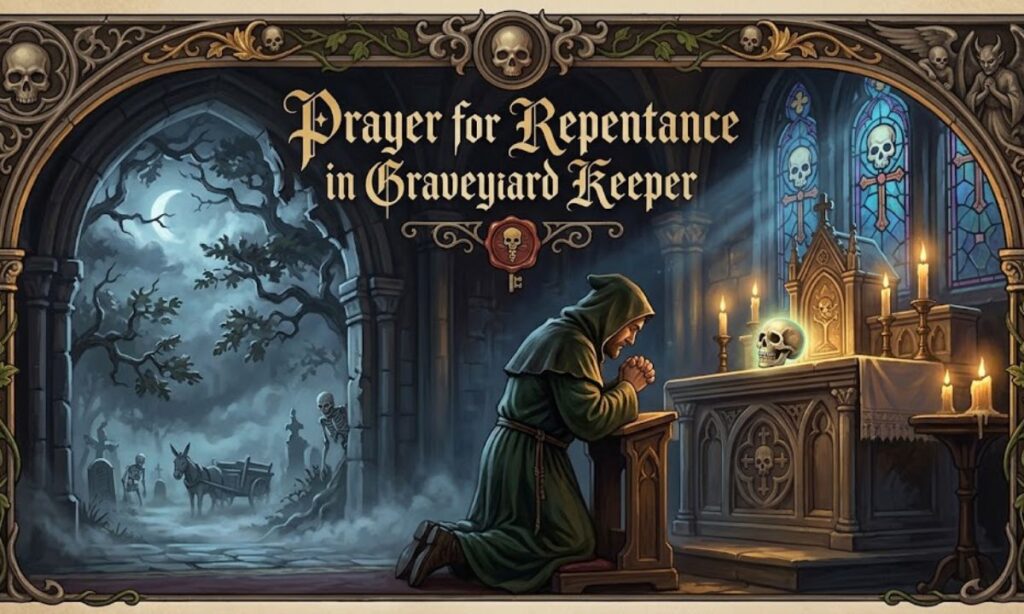
If you landed here searching for something completely different, you’re not alone — “Prayer for Repentance” is also the name of an in-game item in the popular simulation game Graveyard Keeper.
What It Means in the Game
In Graveyard Keeper, sermons are performed at the church lectern, and “Prayer for Repentance” is one of several available options alongside prayers like Prayer for Faith, Prayer for Prosperity, and Prayer for Donations. According to the game’s mechanics, this particular sermon is meant to trigger a Repentance effect, which is supposed to increase the number of townspeople who use the confessional booth during the following week, while also providing a standard boost to faith and donations based on the church’s quality.
However, many players report that this specific prayer doesn’t function as intended. Community discussions and the game’s own wiki note that the Repentance sermon appears to be broken, showing no measurable increase in confessional traffic even after extended use. For players focused purely on maximizing Faith points efficiently, other sermons — like a silver-quality Prayer for Faith or the Combo Prayer — are generally recommended instead, since Prayer for Repentance’s unique bonus doesn’t reliably work.
Like all sermons in the game, Prayer for Repentance is performed at sunrise by standing behind the church lectern and selecting it from the available options. Its baseline reward still scales with your church’s overall quality rating, so even without its supposed confessional bonus, it can still generate a modest amount of Faith and donations — just not noticeably more than other, simpler prayers. If you’re building your church strategy around maximizing Faith efficiently, it’s worth comparing this prayer against alternatives rather than assuming its name implies a special advantage.
It’s a fun reminder that the same words can carry very different meanings depending on where you encounter them — one a spiritual practice thousands of years old, the other a small mechanic inside a pixel-art farming and management game.
FAQ’s
What is the best prayer for repentance?
There’s no single “correct” prayer — sincerity matters more than wording. A simple prayer confessing your sin and asking God to forgive and change you is enough.
How do I know if my repentance is genuine?
Genuine repentance leads to a real change in behavior over time, not just temporary regret or fear of consequences.
Can I repent more than once for the same sin?
Yes. God’s mercy isn’t limited by how many times you return to Him with a sincere heart.
What Bible verse is best for repentance?
1 John 1:9 is one of the most quoted, promising that confessed sin is met with faithful, complete forgiveness.
Is repentance the same as saying sorry?
Not exactly. Saying sorry expresses regret, while repentance includes a decision to actually turn away from the sin.
What is Tawbah in Islam?
Tawbah is the Islamic concept of repentance — sincerely turning back to Allah, feeling remorse, and resolving not to repeat the sin.
Why is repentance important in the Bible?
It restores a right relationship with God, removes the barrier sin creates, and opens the door to spiritual growth and peace.
What’s the difference between repentance and confession?
Confession is admitting what you did; repentance includes confession but also involves a genuine decision to turn away from that sin going forward.
How often should I pray a prayer of repentance?
Many believers make it a regular part of daily prayer, rather than saving it only for major failures.
Does God forgive the same sin more than once?
Yes, Scripture consistently shows that God’s forgiveness isn’t limited by a person’s past failures, as long as repentance is sincere.
Conclusion
Whether you’re carrying quiet guilt over something small or wrestling with a pattern you can’t seem to break, repentance is always available to you. It doesn’t require perfect words, religious credentials, or a spotless track record, just honesty and a willingness to turn back toward God.
David modeled it after his darkest failure. The tax collector modeled it with nothing but humility. The prodigal son modeled it by simply coming home. Each of them found the same thing waiting: mercy, not condemnation.
If guilt has been weighing on you, don’t wait for the “right words.” Bring what you have even a short, simple prayer and trust that God’s promise in 1 John 1:9 still stands today. He is faithful and just to forgive.
