

Most people check prayer times the same way they check the weather quickly, out of habit, without thinking much about where the numbers actually come from. But behind every Fajr countdown or Vespers bell is a surprisingly precise system built on astronomy, tradition, and centuries of scholarship.
Whether you’re a Muslim trying to catch Asr before it slips into Maghrib, a Christian exploring the Liturgy of the Hours, or simply someone curious about how daily prayer schedules work, this guide breaks it all down in plain language. You’ll learn what prayer times actually are, how each one is calculated, why they shift throughout the year, and how to build a prayer routine that fits your life.
What Are Prayer Times, Exactly?
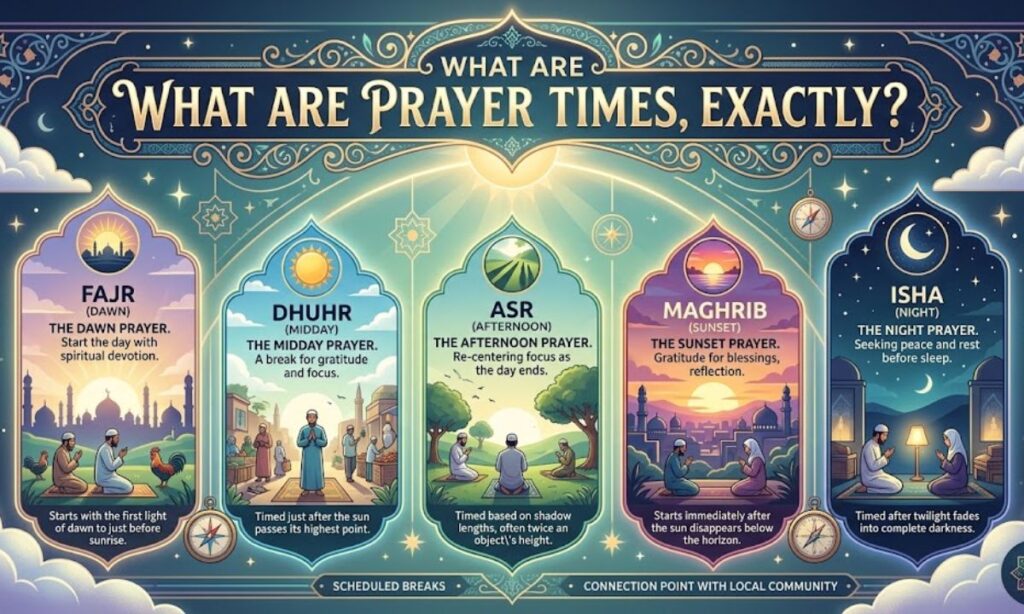
Prayer times are the specific windows during the day set aside for structured worship. They aren’t arbitrary clock times — most are tied to the position of the sun, which is why they change slightly every single day depending on your location and the season.
In practice, “prayer times” usually refers to one of two systems:
- Islamic prayer times (Salah/Namaz) — five daily prayers with fixed start and end windows, calculated using solar angles.
- Christian prayer times (Canonical Hours / Liturgy of the Hours) — a set of prayer periods spread across the day, rooted in monastic tradition and ancient Jewish prayer practice.
Both systems share a common idea: prayer isn’t confined to one moment of the week. It’s woven into the rhythm of daily life, with the sun’s movement acting as a natural clock. That’s also why a prayer times calculator or app needs your exact location — a few miles can shift a prayer window by a minute or two, and a few hundred miles can shift it by much more.
It’s also worth noting that prayer times aren’t unique to Islam and Christianity. Judaism has its own set of fixed prayer times (Shacharit, Mincha, and Maariv), and many other faiths structure worship around the sun, the moon, or the seasons in similar ways. This guide focuses primarily on the Islamic and Christian systems since they’re the two most commonly searched, and because they share such a clear astronomical foundation that makes them easy to compare side by side.
Islamic Prayer Times: The Five Daily Prayers
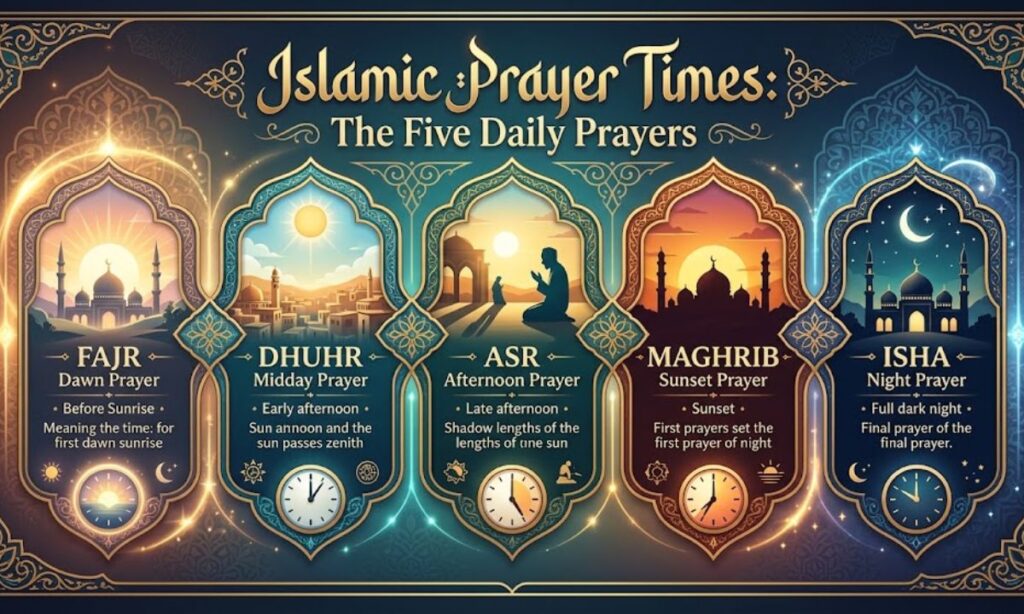
In Islam, Salah (also called Namaz) is one of the Five Pillars, and it’s performed five times a day at fixed intervals determined by the sun’s position. Each prayer has a defined start time and, in most cases, an end time after which the window closes and the next prayer period begins.
Here’s a quick overview before we go into detail:
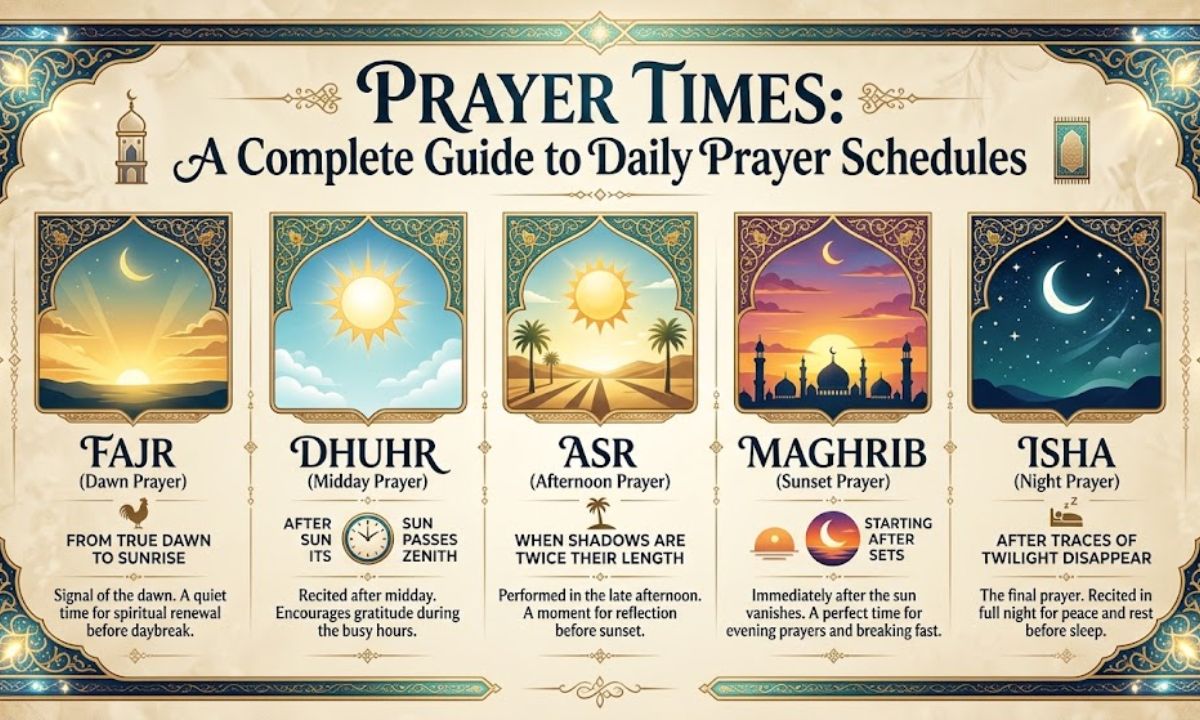
| Prayer | Approx. Time Window | Marks the Start Of |
| Fajr | Dawn, before sunrise | The pre-dawn prayer |
| Dhuhr | Just after solar noon | The midday prayer |
| Asr | Mid-to-late afternoon | The afternoon prayer |
| Maghrib | Just after sunset | The evening prayer |
| Isha | After twilight disappears | The night prayer |
Fajr
Fajr is the first prayer of the day, and it begins at “true dawn” — the moment a faint band of light appears on the horizon, before the sun itself rises. It ends right at sunrise. Because it falls before the sky is fully light, Fajr is often considered one of the more spiritually significant prayers, requiring a level of discipline that the other four don’t quite demand.
Dhuhr
Dhuhr starts once the sun passes its highest point in the sky (solar noon) and begins to decline toward the west. It typically falls somewhere between late morning and mid-afternoon depending on the season and latitude, and it continues until the shadow of an object equals its own length (excluding the shadow cast at noon itself).
Asr
Asr begins right where Dhuhr ends and remains valid until sunset. This is the prayer with the most scholarly variation: the Shafi’i, Maliki, and Hanbali schools calculate Asr when an object’s shadow equals its height, while the Hanafi school waits until the shadow is twice the object’s height. That’s why two prayer apps set to different madhabs (schools of thought) can show Asr times that differ by 30–60 minutes.
Maghrib
Maghrib begins immediately after sunset and is one of the shortest prayer windows of the day. In many traditions it lasts until the last traces of red twilight fade from the western sky. This is also the prayer that marks Iftar, the breaking of the fast, during Ramadan.
Isha
Isha is the final prayer of the day, beginning once twilight has fully disappeared and true darkness sets in. Its end time is debated among scholars — some say it lasts until midnight, others until the following Fajr — but most Muslims aim to complete it well before going to sleep.
How These Prayer Times Are Calculated
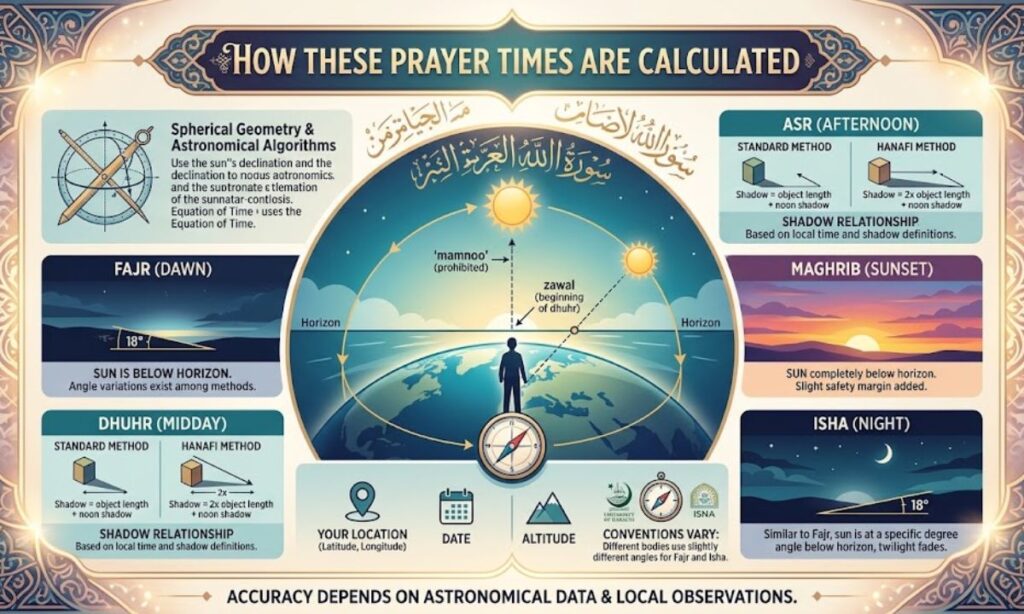
Prayer times aren’t looked up in a static table; they’re calculated fresh for every location and date using astronomical formulas. The core inputs are:
- Latitude and longitude — your exact position on Earth.
- Date — because the sun’s angle relative to the horizon changes daily.
- Time zone and local time offset.
- The equation of time — the small, predictable gap between clock time and true solar time.
- Sun angle conventions — the specific degree below the horizon used to define dawn (Fajr) and the disappearance of twilight (Isha).
That last point is where things get interesting. Different Islamic authorities use slightly different sun angles for Fajr and Isha, which is why the same city can show more than one “correct” timetable. Some of the most widely used conventions include:
| Calculation Method | Fajr Angle | Isha Angle | Commonly Used In |
| Muslim World League | 18° | 17° | Europe, parts of Asia, North America |
| Umm al-Qura (Makkah) | 18.5° | 90 min after Maghrib | Saudi Arabia |
| Egyptian General Authority | 19.5° | 17.5° | Egypt, parts of Africa, Syria |
| University of Islamic Sciences, Karachi | 18° | 18° | Pakistan, Afghanistan, Bangladesh, India |
| Institute of Geophysics, Tehran | 17.7° | 14° | Iran, some Shia communities |
Dhuhr, Asr, and Maghrib are more straightforward because they depend directly on the sun’s observable position rather than a chosen angle — which is also why they tend to match closely across different calculation methods, while Fajr and Isha can vary noticeably.
At very high latitudes — think northern Scandinavia in summer — the sun may never dip far enough below the horizon for true twilight to occur, making standard formulas unusable for weeks at a time. To solve this, scholars developed alternative approaches such as the Angle-Based Method, which divides the night proportionally instead of relying on a fixed sun angle.
Why Fixed Prayer Times Matter
It might seem simpler to just pray “whenever,” so why go through all this astronomical effort? A few reasons come up again and again:
- Structure and discipline. Fixed times turn prayer into a habit rather than an afterthought, anchoring the day around moments of reflection.
- Community and unity. When everyone in a mosque or congregation prays at the same defined window, worship becomes a shared, synchronized act rather than an isolated one.
- Spiritual accountability. Knowing a window will close creates gentle urgency — it’s much easier to keep putting off an “anytime” prayer than one with a deadline.
- Historical continuity. These schedules trace back to scripture, prophetic tradition, and centuries of scholarly consensus, connecting today’s worshippers to a much older practice.
For Muslims specifically, praying within the assigned window is considered essential to the validity of Salah — praying too early or too late (without valid excuse) means the prayer needs to be made up later (qadha). This is one reason accurate, location-based prayer time tools matter so much: a timetable that’s even a few minutes off can mean the difference between a valid prayer and one that needs to be repeated.
Christian Prayer Times: Praying Through the Day
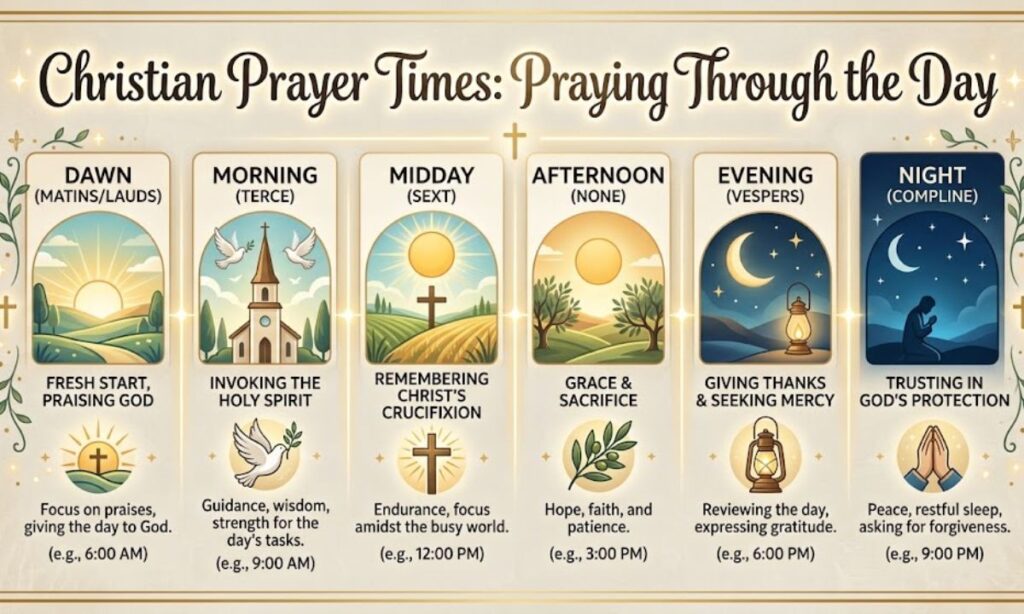
Fixed-hour prayer isn’t unique to Islam. Christianity has its own long-standing tradition of praying at set times throughout the day, known as the canonical hours, the Divine Office, or the Liturgy of the Hours in the Catholic tradition. It traces back to the early Church and, before that, to Jewish prayer customs — early Christian writings describe believers praying as often as seven times a day.
The traditional canonical hours look like this:
| Hour | Traditional Time | Modern Name |
| Matins/Vigils | Midnight | Office of Readings |
| Lauds | Dawn (around 3–6 a.m.) | Morning Prayer |
| Prime | Sunrise (around 6 a.m.) | (Suppressed in modern rite) |
| Terce | Mid-morning (9 a.m.) | Daytime Prayer |
| Sext | Noon | Daytime Prayer |
| None | Mid-afternoon (3 p.m.) | Daytime Prayer |
| Vespers | Sunset (evening) | Evening Prayer |
| Compline | Bedtime | Night Prayer |
Saint Benedict formalized this pattern in the 6th century as part of his Rule for Monasteries, and it’s still followed closely in monastic communities today. After the Second Vatican Council, the Catholic Church simplified the schedule into what’s now called the Liturgy of the Hours, centered on Morning Prayer (Lauds), Evening Prayer (Vespers), and Night Prayer (Compline) as the “hinge hours” of the day, with the Office of Readings and daytime prayers filling in the rest.
Unlike Islamic Salah, the Liturgy of the Hours doesn’t come with strict, non-negotiable start and end windows for lay Catholics. Priests and religious orders are generally expected to pray the full set daily, but for everyday believers, the Church encourages praying close to the intended time rather than at an exact minute. Many other Christian traditions — including Anglican and Orthodox churches — maintain their own versions of this same fixed-hour prayer rhythm, often simplified into morning and evening prayer services.
Building Your Own Schedule
Whether you’re following Salah, the Liturgy of the Hours, or simply want more structured prayer in your day, building a workable schedule comes down to a few practical steps. The goal is to make prayer a natural part of your day rather than an interruption you have to fight for — and that usually comes down to preparation rather than willpower.
- Choose a reliable source for your times. Use a reputable prayer times calculator or app tied to your exact GPS location rather than a generic city-wide estimate, especially if you live near a time zone boundary or at a higher latitude.
- Pick the calculation method that matches your community. If you attend a specific mosque or follow a specific madhab, match your app’s settings to theirs so your times line up with the people you pray alongside.
- Set reminders with buffer time. Rather than an alert right at the start of a window, give yourself 10–15 minutes’ notice so you’re not rushing, especially for shorter windows like Maghrib.
- Anchor prayers to existing habits. Pairing Fajr with your morning alarm, or Vespers with dinner prep, makes the habit far easier to sustain than treating it as a separate task on your calendar.
- Plan around your calendar, not against it. Block out prayer windows the same way you’d block a meeting, especially during busy work hours when Dhuhr or Asr can easily get missed.
- Review and adjust monthly. Because sunrise and sunset shift throughout the year, your personal routine — wake-up time, work schedule, bedtime — may need small seasonal tweaks to stay aligned.
- Keep a simple tracker. A basic checklist or app streak can help build consistency, particularly in the first few weeks of establishing a new habit.
The goal isn’t perfection — it’s consistency. A prayer schedule that’s realistic and sustainable will always outperform an ambitious one that gets abandoned after two weeks.
FAQ’s
What are the 5 daily prayer times in Islam?
The five daily prayers are Fajr (dawn), Dhuhr (midday), Asr (afternoon), Maghrib (sunset), and Isha (night), each performed within its own fixed time window.
Why do prayer times change every day?
Prayer times are based on the sun’s position, and since sunrise, solar noon, and sunset shift daily with the seasons, the prayer windows shift along with them.
Which prayer time calculation method should I use?
Use the method followed by your local mosque or community for consistency; if you’re unsure, the Muslim World League method is one of the most widely accepted defaults worldwide.
What happens if I miss a prayer window?
In Islamic practice, a missed prayer is typically made up later as qadha; in Christian tradition, missing a canonical hour simply means resuming at the next scheduled prayer time.
Do Christian prayer times have strict start and end windows like Salah?
No — outside of monastic and clergy obligations, the Liturgy of the Hours is generally prayed close to the intended time rather than within a strict window.
Why do Sunni and Shia prayer times sometimes differ?
Differences mainly come from how Asr, Maghrib, and Isha are calculated — for example, some Shia scholars wait until the sky’s redness fully passes before Maghrib begins, shifting the time later than the Sunni convention.
Can I combine prayers if I’m traveling or busy?
In Islam, combining Dhuhr with Asr or Maghrib with Isha is permitted in specific circumstances such as travel, illness, or genuine hardship, depending on the school of thought.
Conclusion
Prayer times aren’t just numbers on an app, they’re the product of centuries of astronomical observation, religious scholarship, and lived tradition, all designed to build rhythm and intention into daily life. Whether you’re tracking the five daily Salah windows or following the canonical hours of Christian tradition, understanding how these times are calculated and why they matter makes it far easier to build a routine that actually sticks.
Start simple: pick a reliable source for your times, match it to your community’s method, and anchor each prayer to something you already do every day. The rest is just consistency.
