

Few Catholic devotions ask for as much patience as this one. There’s no nine-day countdown, no single afternoon of prayer, no quick novena to check off a list. Instead, the 12 Year St. Bridget Prayers ask something rare in modern spiritual life: show up every single day, for over a decade, and meditate on the suffering of Christ.
That’s a strange thing to ask for in 2026, when most of us struggle to keep a habit going for two weeks. Yet this devotion has quietly persisted for over 650 years, passed from grandmothers to grandchildren, printed in prayer cards, tucked into missals, and now shared across parish Facebook groups and prayer apps.
This guide brings together everything worth knowing about the devotion: the seven daily prayers themselves, the history behind them, the promises attached to faithful recitation, and what the Catholic Church actually says about all of it. Whether you’re two days in, still deciding whether to start, or just curious what your grandmother has been doing every morning for the last six years, you’ll find a clear answer here.
Quick Summary Table
| Detail | Information |
| Devotion name | 12 Year St. Bridget Prayers (also called the 7 Prayers of the Precious Blood) |
| Number of prayers | 7 prayers, each preceded by an Our Father and a Hail Mary |
| Length of commitment | Daily recitation for 12 consecutive years |
| Related devotion | The 15 Prayers of St. Bridget (a separate, one-year devotion) |
| Revealed to | St. Bridget of Sweden, 14th century |
| Focus of meditation | The seven times Christian tradition holds Jesus shed His Precious Blood |
| Number of promises | 5 promises tied to the 12-year devotion; 21 promises tied to the 15-prayer devotion |
| Church status | Private revelation — not an official Church teaching, but long tolerated and widely practiced |
| Time per day | Roughly 10–20 minutes |
| Best for | Catholics and other Christians seeking a sustained, long-term prayer discipline |
What Are the 12 Year St. Bridget Prayers?
What Is the 12-Year Prayer Devotion?
The 12 Year St. Bridget Prayers are a set of seven short prayers, each one introduced by an Our Father and a Hail Mary, that are recited daily for twelve unbroken years. Together, they walk through seven moments in the life of Christ when tradition holds that He shed His blood — beginning with His circumcision as an infant and ending with the piercing of His side on the cross.
Unlike a novena or a single rosary, this devotion isn’t something you finish in an afternoon. It’s structured as a long, steady rhythm — the kind of prayer that becomes part of your morning coffee, your commute, or your bedtime routine for over a decade.
Why Is It Called the 12-Year Prayer?
The name is simple and literal: it’s twelve years because that’s how long tradition says the devotion must be prayed to honor its full purpose. According to the story attached to the prayers, St. Bridget once asked to know exactly how many blows and wounds Christ suffered during His Passion. The number she received — 5,480 — is said to correspond to the total wounds honored through twelve years of daily recitation of these seven prayers.
Whether or not that figure is taken literally, the underlying idea has stuck: this is a devotion measured not in days or weeks, but in years of a person’s life.
What Makes This Devotion Unique?
A few things set the 12-Year Prayer apart from most other Catholic devotions:
- Length. Twelve years is an extraordinary commitment compared to a novena’s nine days or even a year-long devotion.
- Consistency over intensity. The prayers themselves are short. The challenge isn’t difficulty — it’s persistence.
- A built-in mercy clause. Tradition holds that if someone dies before completing the twelve years, their intention alone is accepted as though the devotion were finished.
- A focus on Christ’s Passion specifically, rather than a broader theme like the rosary’s mysteries or a novena’s particular intercessor.
The Complete 7 Prayers of the 12-Year Devotion
Each of the seven prayers is recited once daily, and each is preceded by one Our Father and one Hail Mary. Rather than reproducing the prayer texts word for word (they’re widely available through Catholic devotional publishers and parish prayer cards), here’s what each of the seven prayers meditates on:
- The Circumcision — Christ’s first shedding of blood as an infant, offered for the forgiveness of the sins of one’s youth.
- The Agony in the Garden — the bloody sweat of Christ at Gethsemane, offered for deliverance from the sins of the heart.
- The Scourging at the Pillar — the wounds of the scourging, offered for mortification of the flesh and victory over temptation.
- The Crowning with Thorns — the piercing of Christ’s head, offered for guidance and clarity of mind.
- The Carrying of the Cross — the wounds from carrying the cross to Calvary, offered for patience under trial.
- The Crucifixion — the nailing of Christ’s hands and feet, offered for strength in following God’s will.
- The Piercing of the Side — the final wound from the lance, offered for union with Christ’s Sacred Heart.
Each prayer opens with a meditation on the physical suffering of that moment and closes with a specific spiritual intention — a structure that turns the devotion into both remembrance and petition.
Who Was St. Bridget of Sweden?
Early Life
Bridget was born around 1303 in Uppland, Sweden, into a wealthy and deeply religious noble family. <cite index=”21-1″>Her parents, Birger Petersson and Ingeborg Bengtsdotter, belonged to families of nobility closely related to the royal family and were known for their devotion and virtuous life.</cite> She lost her mother while still young and <cite index=”21-1″>was raised largely by an aunt who gave her instruction in religion and virtue.</cite>
<cite index=”20-1″>Even as a child, Bridget experienced a dream-vision of the Man of Sorrows an image of Christ bearing the wounds of Good Friday.</cite> When she asked who had hurt Him, tradition says <cite index=”20-1″>Christ replied that it was those who despised Him and refused His love.</cite> That early encounter shaped the rest of her spiritual life.
At just thirteen, Bridget was married to Ulf Gudmarsson, a nobleman a few years older than her. <cite index=”23-1″>The marriage proved a happy one, blessed with eight children, including a daughter who would later become St. Catherine of Sweden.</cite> Bridget balanced a busy family life with growing charitable work, reportedly arranging for a hospital to be built on the family estate.
Her Mystical Visions
After her husband’s death in 1344, Bridget dedicated the rest of her life fully to prayer, penance, and mystical experience. <cite index=”23-1″>She founded a religious congregation, the Order of the Most Holy Savior — known today as the Bridgettines — with its motherhouse at Vadstena, richly endowed by King Magnus and his queen.</cite>
Bridget’s visions were extensive and were later compiled into a large body of writing known as the Revelations. <cite index=”24-1″>These revelations were influential throughout the Middle Ages and were first published in 1492, later appearing in many languages.</cite> Among these visions is the account behind the 12-Year and 15 Prayers devotions — a vision in which Christ is said to have described the exact suffering of His Passion in response to Bridget’s persistent questioning.
Canonization
Bridget spent her final years in Rome, working to convince the Pope to return the papacy from Avignon back to Rome, and eventually made a pilgrimage to the Holy Land with two of her children. She died in Rome on July 23, 1373. <cite index=”17-1″>Pope Boniface IX canonized her as St. Bridget of Sweden on October 7, 1391, making her Sweden’s only universally recognized Catholic saint.</cite>
Legacy in Christianity
Bridget’s influence reaches well beyond her prayer devotions. <cite index=”24-1″>In 1999, Pope John Paul II named her one of the patron saints of Europe, alongside St. Catherine of Siena and St. Teresa Benedicta of the Cross.</cite> <cite index=”20-1″>The Bridgettine order she founded is still active today, with monasteries operating across Europe.</cite> Her feast day is celebrated on July 23.
The History and Origin of the 12 Year St. Bridget Prayers
The Vision of Jesus Christ
According to devotional tradition, Bridget had long wanted to know precisely how much Christ had suffered during His Passion — every blow, every wound. The story holds that Christ eventually appeared to her and told her the number: 5,480 individual wounds. To honor this suffering, He is said to have taught her a set of prayers to be recited daily, so that by the end of the prescribed period, every wound would have been spiritually honored.
This is the origin point of both the 12-Year devotion and the related 15 Prayers devotion — two distinct prayer sets that grew out of the same vision but took different shapes over the centuries.
Historical Background
The prayers first circulated in manuscript and print form in the centuries following Bridget’s death, spreading through convents, monasteries, and popular devotional literature across Europe. Versions of the prayers appeared in printed prayer books as early as the 1700s, and later editions carried formal ecclesiastical approval — a sign that Church authorities of the time saw no doctrinal issue with the text, even while treating the underlying visions as private revelation rather than official teaching.
How the Devotion Spread Around the World
From its European origins, the devotion travelled with Catholic immigration, missionary work, and the printing and distribution of prayer cards. It’s now prayed by Catholics — and by curious non-Catholic Christians — across the Americas, Africa, and Asia, largely passed down through parish life, family tradition, and more recently, online prayer communities and devotional apps. The devotion’s endurance over six and a half centuries is itself part of what continues to draw new people to it today.
What Are the 15 Prayers of St. Bridget?
Why There Are 15 Prayers
The 15 Prayers of St. Bridget are a separate, shorter devotion drawn from the same tradition of visions. Instead of stretching across twelve years, this version is recited daily for one full year. Where the 12-Year devotion focuses on seven specific moments Christ shed His blood, the 15 Prayers meditate more broadly on the physical and emotional suffering of the entire Passion — from the Agony in the Garden through the Crucifixion and beyond.
What Each Prayer Focuses On
The fifteen prayers move through the Passion almost like stations, each one dwelling on a different wound, moment, or emotion — Christ’s fear in the garden, the physical brutality of the scourging, the weight of carrying the cross, His words from the cross, and His final surrender on Calvary. Each prayer is paired with an Our Father and a Hail Mary, similar in structure to the 12-Year devotion.
Where to Find the Complete 15 Prayers
The full text of the 15 Prayers is widely available through Catholic publishers, parish prayer cards, and devotional websites, often printed alongside the traditional list of promises. Many prayer books, including well-known devotional collections used in parishes, include the complete text along with historical notes on its approval history.
How to Pray the 12 Year St. Bridget Prayers
Step-by-Step Daily Prayer Guide
- Find a quiet moment — ideally the same time each day, so the devotion becomes a fixed part of your routine.
- Begin with a brief moment of stillness or a Sign of the Cross to settle your mind.
- Pray one Our Father and one Hail Mary before the first prayer.
- Recite the first of the seven prayers slowly, reflecting on the moment of Christ’s suffering it describes.
- Repeat the Our Father, Hail Mary, and prayer pattern for all seven prayers in sequence.
- Close with a short personal prayer or intention — this is a natural place to remember loved ones or specific needs.
- Mark your calendar or journal so you can track your progress across the twelve years.
Best Time to Pray
There’s no official rule about timing, but most people who complete the devotion recommend praying at the same time every day — commonly first thing in the morning, before the day’s distractions set in, or in the quiet of evening before bed. What matters more than the specific hour is consistency: picking a time you can realistically protect for over a decade.
Preparing Your Heart Before Prayer
A few minutes of quiet before beginning helps the prayers land with more meaning than simply reciting words. Some people light a candle, sit before a crucifix or icon, or take a few slow breaths to shift out of a rushed mindset. The goal isn’t ritual for its own sake — it’s simply giving your attention time to catch up with your intention before you begin.
Sample Daily Prayer Routine
| Time | Activity |
| Morning (5 minutes) | Sign of the Cross, brief silence, opening intention |
| Prayers (10 minutes) | Recite all seven prayers with accompanying Our Fathers and Hail Marys |
| Closing (2–3 minutes) | Personal intention, gratitude, or a request for perseverance |
How Long the Daily Prayers Take?
Most people complete the full set of seven prayers, along with the accompanying Our Fathers and Hail Marys, in roughly 10 to 20 minutes, depending on how slowly and reflectively they pray. It’s a manageable daily commitment — the real challenge is less about time and more about staying faithful to it for twelve straight years.
Why Is the Devotion Prayed for 12 Years?
The Spiritual Meaning of the Number 12
Twelve carries deep symbolic weight throughout Scripture — the twelve tribes of Israel, the twelve apostles, the twelve gates of the New Jerusalem in Revelation. In this devotion, the twelve-year span is tied to the tradition of Christ’s 5,480 wounds, but it also echoes this broader biblical pattern of twelve representing completeness and fullness — a full cycle of devotion rather than a fragment.
Is the 12-Year Commitment Mandatory?
No civil or Church law requires anyone to complete exactly twelve years. The timeframe comes from devotional tradition, not canon law. It functions as a spiritual goal and a framework for the promises attached to the devotion, not a binding obligation enforced by the Church.
Can You Pray the Devotion for Less Than 12 Years?
Yes. Many people begin the devotion without completing the full twelve years, whether due to changing circumstances, health, or simply losing the habit. The prayers themselves remain spiritually valuable regardless of how long they’re prayed — the twelve-year framework is the traditional structure for the devotion’s full promises, not a requirement for the prayers to have meaning.
What Is the Purpose of the 12 Year St. Bridget Devotion?
Meditating on Christ’s Passion
At its core, this devotion exists to keep the suffering of Christ present in daily consciousness — not as a single Good Friday reflection once a year, but as a daily habit of remembering what Christian tradition holds He endured out of love.
Growing Closer to Jesus
Repetition, far from making prayer stale, tends to deepen it over time for those who stay with it. Praying the same seven meditations daily for years creates a kind of ongoing conversation — one that shifts and deepens as the person praying moves through different seasons of their own life.
Developing a Consistent Prayer Life
For many people, the appeal of this devotion isn’t really about the twelve-year endpoint — it’s about the discipline itself. Committing to any daily practice for that long naturally builds a stronger overall prayer life, one that often continues well beyond the devotion’s completion.
Strengthening Faith Through Daily Devotion
A prayer practiced this consistently becomes woven into ordinary life — into grief, into celebration, into monotony and crisis alike. That steady presence is, for many devotees, the real fruit of devotion: a faith that doesn’t depend on feeling inspired every day, but simply shows up.
The 21 Promises of the 12 Year St. Bridget Prayers
What Are the 21 Promises?
It’s worth clarifying some common confusion here: the 21 promises are traditionally associated with the 15 Prayers devotion (the one-year practice), not the 12-Year devotion, which carries its own separate set of five promises. Because the two devotions share the same origin story, they’re frequently mixed up online.
The 5 promises tied to the 12-Year devotion include:
- Exemption from the pains of Purgatory
- Being counted among the martyrs, as though blood had been shed for the faith
- The ability to choose three people whom the Lord will keep in a state of grace
- Protection for four generations of one’s own family from being eternally lost
- Advance awareness of one’s death, a month before it occurs
The 21 promises tied to the 15 Prayers devotion are more extensive, and include assurances such as the deliverance of family members from Purgatory, protection from sudden death, spiritual strength against temptation, and the granting of requests made through prayer, among others.
What Do These Promises Mean?
Read plainly, the promises describe extraordinary spiritual rewards for sustained faithfulness — protection, grace for loved ones, and peace at the hour of death. Most spiritual writers who discuss devotion encourage reading these promises as expressions of God’s generosity toward persistent faith and prayer, rather than as guaranteed transactions in a strict, contractual sense.
Are the Promises Official Church Teaching?
No. The promises come from private revelation, and the Catholic Church has never formally certified them as guaranteed outcomes. In fact, in 1954, the Holy Office restricted the publication of the list of promises attached to the 15 Prayers, noting that the promises themselves carry no independent doctrinal merit while the prayers as a meditation on the Passion remained perfectly acceptable.
How Should Christians Understand These Promises?
The most balanced approach treats the promises as devotional encouragement rather than doctrine. The prayers themselves reflect Christ’s suffering, sustained daily discipline, intercession for loved ones carry spiritual value on their own, independent of whether every specific promise is understood literally.
Is the 12 Year St. Bridget Prayer Approved by the Catholic Church?
What Does the Catholic Church Say?
The Church has never issued a formal doctrinal statement either approving or condemning the 12-Year devotion as such. Historically, various editions of the related 15 Prayers carried ecclesiastical approval for publication — meaning bishops of the time found nothing objectionable in the text — but that’s different from the Church declaring the visions themselves, or the promises attached to them, to be certainly true.
Public Revelation vs. Private Revelation
Catholic teaching distinguishes between public revelation — the deposit of faith completed with the death of the last Apostle, contained in Scripture and Tradition — and private revelation, which includes mystical experiences like those of St. Bridget. Private revelations, even when treated respectfully by the Church, are never binding on the faithful. Catholics are free to find them spiritually helpful without being obligated to believe every detail.
Are Catholics Required to Pray This Devotion?
No. Like the rosary, novenas, and other popular devotions, praying the 12-Year St. Bridget Prayers is entirely optional. It’s a personal devotional choice, not a requirement of the faith.
What Catholics Should Know Before Beginning?
- The devotion is a private revelation, not a Church-mandated practice.
- The specific promises shouldn’t be treated as guarantees in a legalistic sense.
- The prayers themselves are a legitimate and valuable meditation on Christ’s Passion.
- The devotion should complement — not replace — the sacraments, Scripture, and regular Church life.
Are the 12 Year St. Bridget Prayers Biblical?
Christ’s Passion in Scripture
The suffering the prayers meditate on — the scourging, the crown of thorns, the crucifixion, the piercing of Christ’s side — is drawn directly from the Gospel accounts of the Passion. While the specific number of wounds (5,480) comes from private revelation rather than Scripture, the underlying events being honored are firmly biblical.
Bible Verses About Prayer
Scripture repeatedly encourages sustained, persistent prayer — a theme that resonates directly with a twelve-year devotional commitment. Passages like 1 Thessalonians 5:17, which calls believers to “pray without ceasing,” and Luke 18’s parable of the persistent widow both support the value of ongoing, faithful prayer over time.
Bible Verses About Perseverance
The New Testament often frames the Christian life itself as a race requiring endurance. Hebrews 12:1 speaks of running “with perseverance the race marked out for us” — language that fits naturally with a devotion measured in years rather than moments.
How This Devotion Reflects Biblical Teachings?
While the 12-Year Prayer isn’t itself a biblical text, its content and spirit draw heavily on Scripture: meditation on Christ’s suffering, commitment to sustained prayer, and trust in God’s mercy across a long span of time. It functions as a devotional application of biblical themes rather than an addition to Scripture itself.
Bible Verses That Complement the St. Bridget Prayers
Isaiah 53
This prophetic chapter describes the suffering servant “wounded for our transgressions” and “bruised for our iniquities” — language that Christian tradition has long connected directly to Christ’s Passion, making it a natural companion reading for this devotion.
John 19
The Gospel of John’s account of the Passion — the scourging, the crown of thorns, the crucifixion, and the piercing of Christ’s side with a lance — maps closely onto the seven moments honored in the 12-Year Prayer, particularly the final prayer focused on His side.
Hebrews 12:2
This verse calls believers to fix their eyes on Jesus, who endured the cross for the joy set before Him — a fitting theme for a devotion built entirely around sustained focus on Christ’s endurance.
Philippians 2:8
Paul’s description of Christ humbling Himself “to the point of death, even death on a cross” captures the same spirit of self-giving love that the seven prayers meditate on daily.
1 Peter 2:24
This verse speaks of Christ bearing sins “in his body on the tree” so that believers might live for righteousness — directly echoing the devotion’s theme of honoring Christ’s wounds as an act of redemption.
Benefits of Praying the 12 Year St. Bridget Prayers
Spiritual Growth
Sustained daily prayer, practiced over years rather than days, tends to produce gradual but lasting change in a person’s spiritual life — a slow deepening rather than a sudden transformation.
A Deeper Relationship with Jesus
Returning to the same meditations day after day creates familiarity with Christ’s suffering that becomes personal rather than abstract, shaping how someone relates to Him across ordinary life.
Greater Peace and Hope
Many who complete or work through the devotion describe a growing sense of peace, especially during hard seasons — the prayers becoming an anchor point regardless of what else is happening around them.
Building a Lifelong Prayer Habit
Twelve years is long enough that the discipline of daily prayer often becomes permanent, continuing well past the technical completion of the devotion itself.
Finding Strength During Difficult Times
Because the prayers meditate directly on suffering, many people find them especially meaningful during their own periods of grief, illness, or hardship — a way of uniting personal pain with Christ’s own.
Who Should Pray the 12 Year St. Bridget Prayers?
Catholics
For practicing Catholics, this devotion fits naturally alongside the rosary, novenas, and other traditional prayer practices, offering a longer-term complement to shorter daily devotions.
New Christians
Those newer to the faith may find the devotion’s structure — the same short prayers repeated daily — an accessible way to build a prayer habit without needing extensive theological background.
Long-Time Believers
For lifelong Christians seeking to deepen an already-established prayer life, the twelve-year commitment offers a fresh, structured way to engage with familiar territory: the Passion of Christ.
Anyone Seeking a Deeper Prayer Life
Even those outside the Catholic tradition who are drawn to structured meditation on Christ’s suffering may find value in the devotion’s rhythm, regardless of denominational background.
Can You Pray the St. Bridget Prayers Without Completing the 12-Year Devotion?
Daily Devotion vs. Long-Term Commitment
Yes — nothing prevents someone from praying the seven prayers occasionally, or for a shorter period, without committing to the full twelve-year framework. The prayers can be prayed on Good Friday, during Lent, or as a standalone daily practice for any length of time.
Is It Still Spiritually Beneficial?
Absolutely. The meditative value of reflecting on Christ’s Passion doesn’t depend on reaching a twelve-year finish line. Many spiritual directors would say the heart behind the prayer matters more than the calendar attached to it.
What Happens If You Miss a Day?
Should You Start Over?
No formal rule requires restarting the twelve-year count after a missed day. Most devotional guides treat a missed day as something to simply make up as soon as possible, rather than a reason to abandon or restart years of progress.
Practical Advice for Staying Consistent
- Set a daily reminder on your phone at the same time each day.
- Keep a small prayer card or booklet somewhere visible, like your nightstand or car.
- Pair the devotion with an existing habit, such as morning coffee or a commute.
- Don’t let one missed day spiral into abandoning the whole practice — simply resume the next day.
How to Build a Lasting Prayer Habit
Treat occasional lapses as normal rather than catastrophic. The devotion is meant to shape a heart of perseverance, and part of that perseverance is the willingness to keep returning after an imperfect stretch, rather than expecting flawless execution across 4,380-plus days.
Do People Experience Miracles Through the St. Bridget Prayers?
Inspiring Testimonies and Personal Experiences
Across parish communities and online devotional groups, it’s common to find personal stories of comfort, healing, or answered prayer connected to this devotion. These accounts are widely shared but remain personal testimonies rather than officially documented or Church-verified miracles.
Understanding Miracles in the Christian Faith
Catholic teaching holds that God can and does act through sincere prayer, but it also cautions against treating any specific devotion as a guaranteed mechanism for miracles. Genuine faith and humility matter more than expecting a particular outcome from a particular prayer.
A Balanced Perspective on Spiritual Testimonies
Personal testimonies can be encouraging without needing to be treated as proof of a formula. The healthiest approach holds these stories with gratitude and openness, while recognizing that God’s action in anyone’s life isn’t something a devotion can compel.
Common Myths About the 12 Year St. Bridget Prayers
Myth #1: Missing One Day Cancels the Devotion
This is one of the most widespread misunderstandings. Devotional tradition treats a missed day as something to make up, not something that voids years of prior faithfulness.
Myth #2: The Promises Guarantee Salvation
The promises describe extraordinary graces, but Catholic teaching never treats any private devotion as an automatic guarantee of salvation, which remains tied to grace, faith, and a life lived in relationship with God — not to the mechanical completion of any prayer.
Myth #3: Every Catholic Must Pray These Prayers
This devotion, like nearly all popular Catholic devotions, is entirely voluntary. It’s never been a Church requirement.
Myth #4: These Prayers Replace the Bible or the Sacraments
The devotion is meant to complement, not substitute for, Scripture reading, Mass attendance, and the sacraments — which remain central to Catholic spiritual life regardless of any personal devotional practice.
Common Mistakes to Avoid While Praying
Praying Without Reflection
Reciting the words quickly without engaging the meaning behind them turns the devotion into rote repetition rather than genuine prayer. Slowing down, even slightly, makes a meaningful difference.
Rushing Through the Prayers
Because the prayers are short, it’s tempting to speed through all seven in a few minutes without pause. Building in small moments of silence between prayers helps prevent this.
Focusing Only on the Promises
Approaching the devotion mainly as a means to specific rewards can shift the heart away from genuine love and toward transactional thinking — the opposite of the devotion’s spirit.
Neglecting Scripture and Church Life
Treating this devotion as a replacement for Mass, confession, or Bible reading misunderstands its role. It’s meant to sit alongside these practices, not stand in for them.
Tips for Successfully Completing the 12-Year Devotion
Create a Daily Prayer Routine
Anchor the prayers to a specific time and place each day so they become automatic rather than something you have to remember to fit in.
Set Prayer Reminders
A recurring phone alarm or calendar notification removes the guesswork of remembering, especially in the early months before the habit fully sets in.
Keep a Prayer Journal
Recording your start date, occasional reflections, and the names of those you’re praying for can turn the devotion into a living record of your spiritual journey across the twelve years.
Join a Prayer Group or Community
Praying alongside others — even informally, through a group chat or parish prayer circle — adds accountability and shared encouragement over such a long stretch of time.
Stay Encouraged During Difficult Seasons
There will be seasons of dryness or distraction. Treating those seasons as a normal part of any long commitment, rather than a sign of failure, makes it far more likely you’ll still be praying in year eleven.
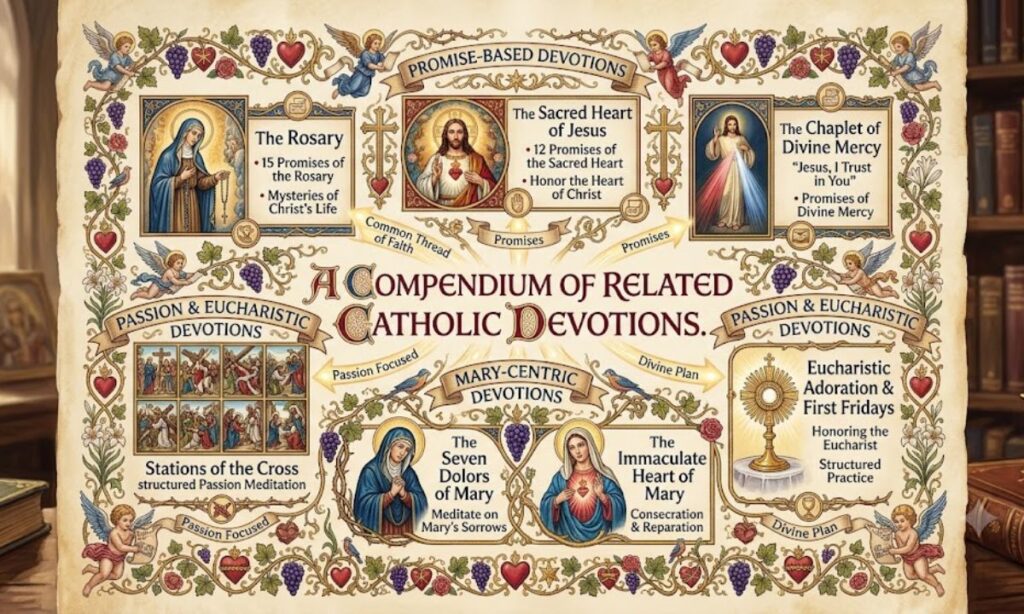
Related Catholic Devotions
The Holy Rosary
A daily meditation on the joyful, sorrowful, glorious, and luminous mysteries of Christ’s life, prayed using rosary beads — one of the most widely practiced Catholic devotions worldwide.
Divine Mercy Chaplet
A shorter daily prayer focused on God’s mercy, especially popular when prayed at 3:00 p.m., the traditional Hour of Mercy associated with Christ’s death.
Stations of the Cross
A devotional walk through fourteen (traditionally) moments of Christ’s Passion, commonly prayed during Lent and especially on Good Friday.
Sacred Heart Devotion
A devotion centered on the love of Christ symbolized by His Sacred Heart, often including the First Fridays practice of monthly Mass and Communion.
Popular Catholic Novenas
Nine-day prayer periods directed toward a particular saint or intention, ranging from the Novena to the Sacred Heart to novenas honoring specific saints ahead of their feast days.
FAQ’s
What are the 12 Year St. Bridget Prayers?
They’re a set of seven daily prayers, prayed for twelve consecutive years, meditating on the seven times tradition holds Jesus shed His blood during His life and Passion.
How many prayers are in the 12-Year devotion?
There are seven prayers, each preceded by an Our Father and a Hail Mary.
Is the 12-Year devotion the same as the 15 Prayers?
No. The 15 Prayers are a separate one-year devotion, while the 12-Year Prayer focuses on seven specific prayers recited daily over twelve years.
Are the promises attached to these prayers official Church teaching?
No. They come from private revelation and have never been formally declared official Church doctrine.
What happens if I miss a day during the 12 years?
Most devotional guidance says to simply make up the prayer as soon as possible rather than restarting the entire devotion.
Can non-Catholics pray the St. Bridget Prayers?
Yes. While rooted in Catholic tradition, any Christian drawn to meditating on Christ’s Passion can pray them.
How long does it take to pray the seven prayers each day?
Typically around 10 to 20 minutes, depending on pace and reflection.
Is the 12-Year devotion approved by the Catholic Church?
It has never been formally condemned or formally declared binding; it’s treated as a private devotion, similar to many other popular Catholic prayer practices.
Where did the 12-Year Prayers come from?
They trace back to a vision St. Bridget of Sweden received in the 14th century concerning the wounds Christ suffered during His Passion.
Do I need special permission to start the devotion?
No. Anyone can begin the devotion at any time without needing formal permission from a priest or bishop.
Conclusion
The 12 Year St. Bridget Prayers aren’t flashy. There’s no dramatic ritual, no single climactic moment — just seven short prayers, repeated daily, for longer than most people keep any habit at all. And maybe that’s exactly the point. In a spiritual culture that often chases quick fixes and instant peace, this devotion asks for something older and slower: showing up, day after day, year after year, to sit with the suffering and love of Christ.
Whether you’re drawn by the promises, the history, or simply the discipline itself, starting the devotion doesn’t require certainty about every detail of St. Bridget’s visions. It only asks for a willingness to begin and to keep returning tomorrow.
