

Cambridge is home to a growing Muslim community, from students at the University of Cambridge to families settled across Romsey, Mill Road, Arbury, and the wider city. Whether you’re praying at home, at work, or heading to a local mosque, knowing the correct Salah times is essential for keeping up with your five daily prayers.
This guide gives you everything you need in one place: today’s prayer times in Cambridge, a monthly timetable structure, Jummah timings, Ramadan Sehri and Iftar times, Qibla direction, and a breakdown of exactly how these times are worked out for this part of the UK. We’ve also included short duas for Fajr and Iftar, plus answers to the questions Cambridge Muslims ask most often about namaz timings.
Because prayer times shift every single day with the movement of the sun, always cross-check the exact minute-by-minute figures against a live source, such as Cambridge Central Mosque’s published timetable or a trusted prayer times app, before you pray. This article explains the patterns, the calculation logic, and what to expect throughout the year, so you can read any daily timetable with confidence.
Unlike cities closer to the equator, Cambridge sees fairly dramatic seasonal swings in daylight. That means the gap between Fajr and Isha can stretch to almost 20 hours in June and shrink to around 10 hours in December. Understanding why this happens, and how local mosques and prayer apps handle it, will help you make sense of any timetable you look at, whether it’s printed on a mosque noticeboard, shown in an app, or listed on a website like this one.
This page is written for the Cambridge Muslim community specifically, students, families, NHS and university staff, and visitors alike, so every section focuses on what’s actually relevant to praying accurately in this city rather than generic national averages.
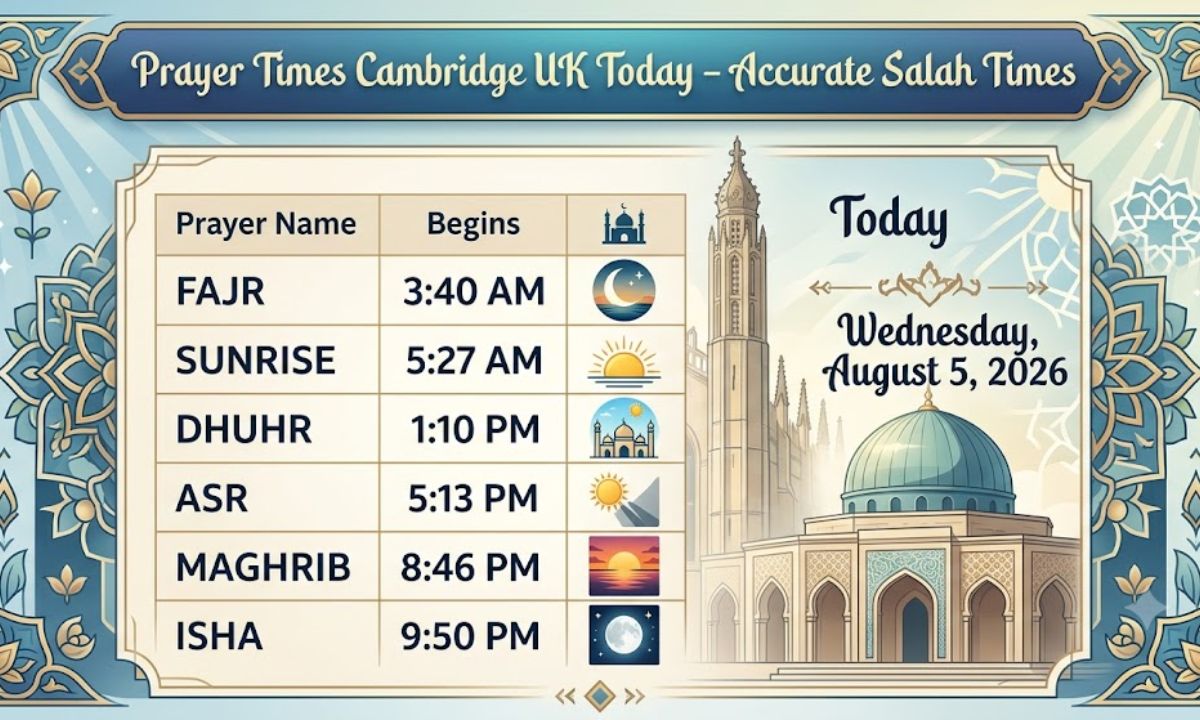
Prayer Times Cambridge UK Today
Cambridge sits at roughly 52.2°N latitude, which means it experiences noticeably longer daylight hours in summer and shorter days in winter compared to cities closer to the equator. This directly affects Fajr, Maghrib, and Isha timings throughout the year.
Below is a sample structure of how today’s prayer times are typically laid out for Cambridge. Treat the timings as illustrative of the pattern rather than the exact minute for today, since the real figures move by a minute or two daily and should always be confirmed against a live timetable.
| Prayer | Approximate Time Pattern (Summer) | Approximate Time Pattern (Winter) |
| Fajr | Early, around 3:30–4:30 AM | Later, around 6:00–6:45 AM |
| Sunrise | Around 5:00–5:45 AM | Around 7:50–8:10 AM |
| Zuhr (Dhuhr) | Around 1:00–1:10 PM | Around 12:00–12:10 PM |
| Asr | Around 5:00–6:15 PM | Around 1:30–2:30 PM |
| Maghrib | Around 8:45–9:30 PM | Around 3:50–4:30 PM |
| Isha | Around 10:45–11:30 PM | Around 5:30–6:30 PM |
Key things to remember about today’s prayer times in Cambridge:
- Times are based on Cambridge’s exact coordinates, not a nearby city, so results can differ slightly from London or Birmingham.
- The clocks change twice a year (British Summer Time), which shifts all five prayers by an hour overnight.
- Fasting and worship apps usually let you pick a calculation method, so two apps can show times that differ by a few minutes for the same day.
- Always check the mosque’s noticeboard or website for the congregational (Jama’at) time, which is often slightly later than the calculated Adhan time.
Why “today’s” time matters more than a fixed number:
Unlike a city near the equator, where prayer times barely move across the year, Cambridge’s timings drift by one to three minutes almost every single day. Over a week, that drift becomes noticeable, and over a month, Fajr or Isha can move by 20–30 minutes. This is precisely why bookmarking a single “today’s time” isn’t reliable long term; instead, it’s worth understanding the pattern of movement described throughout this guide, and pairing that understanding with a live source you check regularly.
How to read a daily timetable correctly:
- Look for both the Adhan (start) time and the Jama’at (congregation) time; they are not the same thing.
- Note whether the source uses 12-hour or 24-hour format, since 6:00 could mean either 6:00 AM or 6:00 PM.
- Check the calculation method listed, since a source using the Hanafi Asr method will show a later Asr time than one using the Standard method.
- Confirm the source is set to Cambridge itself and not simply “UK” as a whole, which can default to London.
Monthly Prayer Timetable Cambridge
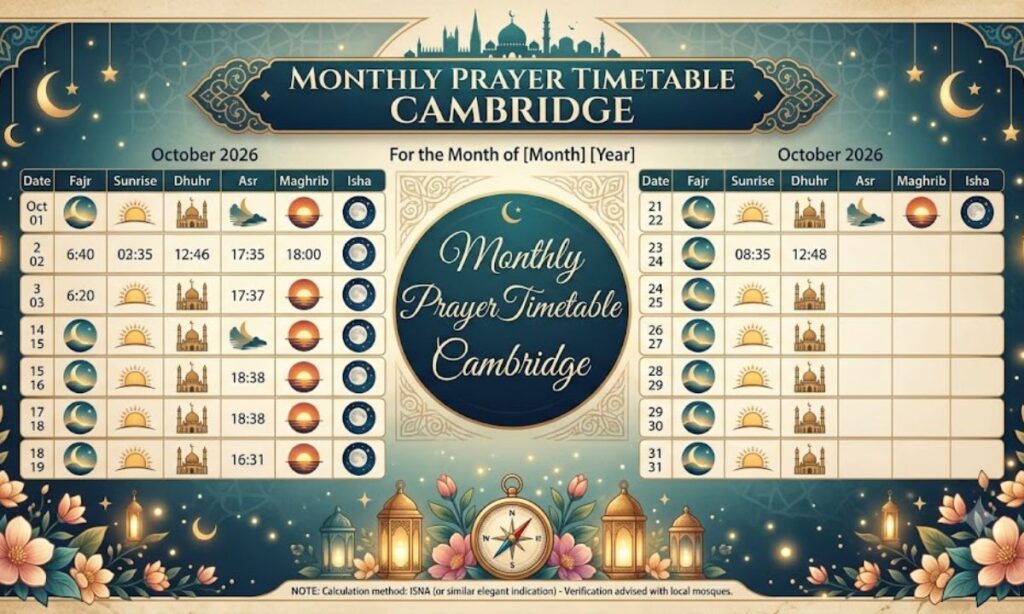
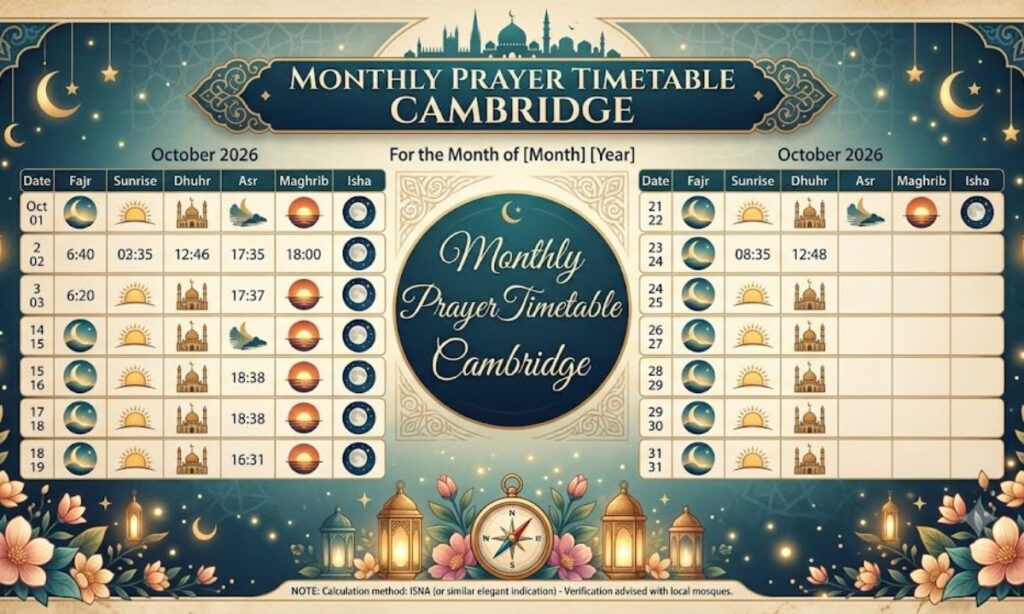
A monthly timetable is the most practical way to plan your prayers in advance, especially for Fajr and Isha, which move the most across the month. Cambridge mosques, including Cambridge Central Mosque on Mill Road, publish printable monthly Salah timetables that show both the Adhan (start) time and the Jama’at (congregation) time for each prayer.
Why a monthly table matters more here than in other regions:
- Cambridge’s high latitude means Fajr and Isha shift by several minutes within a single week during spring and autumn.
- A monthly table helps you set consistent alarms rather than checking daily.
- Students and shift workers often plan their week around Zuhr and Asr, which move more gradually.
Typical layout of a Cambridge monthly prayer timetable:
| Date | Fajr | Sunrise | Zuhr | Asr | Maghrib | Isha |
| 1st | Varies | Varies | Varies | Varies | Varies | Varies |
| 8th | Varies | Varies | Varies | Varies | Varies | Varies |
| 15th | Varies | Varies | Varies | Varies | Varies | Varies |
| 22nd | Varies | Varies | Varies | Varies | Varies | Varies |
| 30th | Varies | Varies | Varies | Varies | Varies | Varies |
For an accurate month-by-month PDF, Cambridge Central Mosque publishes a downloadable timetable each year, which is a reliable reference point since it’s used for the actual congregational prayers in the city.
Benefits of keeping a printed or saved monthly timetable:
- You can plan work meetings, university lectures, or travel around prayer windows well in advance.
- Parents can plan school runs and family routines around Maghrib and Isha shifts.
- It removes the need to check an app every single day, especially useful for elderly worshippers who may prefer a printed copy on the fridge or in a diary.
- It helps you notice upcoming clock changes (British Summer Time) before they catch you off guard.
Many Cambridge households keep last year’s monthly timetable alongside this year’s as a rough guide, since the pattern of movement repeats closely from one year to the next, even though the exact minute shifts slightly due to the leap year cycle and moon-based Islamic events.
Fajr Time In Cambridge UK
Fajr is the dawn prayer, and it begins at true dawn, when the first light appears on the horizon, and ends just before sunrise. In Cambridge, Fajr is one of the most variable prayers across the calendar year because of the city’s northern latitude.
A few practical points about Fajr in Cambridge:
- In the depths of winter, Fajr can start as late as 6:30–6:45 AM.
- In peak summer, Fajr can begin before 3:30 AM, and during a short window in June, true astronomical darkness barely occurs, which is why some calculation methods apply special adjustments for high-latitude cities like Cambridge.
- Fajr consists of 2 Sunnah rak’ahs followed by 2 Fardh rak’ahs.
- Many Cambridge mosques hold a shortened congregation for Fajr on weekdays and a slightly later one on weekends to accommodate more worshippers.
Setting a reliable alarm 15–20 minutes before the calculated Fajr time gives you enough margin to make wudu and pray Sunnah before the Fardh prayer begins.
Why Fajr is often the hardest prayer to keep in Cambridge:
During British Summer Time, Fajr can fall before most people’s normal wake-up alarm, which makes it easy to sleep through without a dedicated reminder. During winter, the opposite problem occurs: Fajr arrives so late that it can overlap with the start of the working day for early commuters. A few practical habits that Cambridge residents use to stay consistent include:
- Placing your phone or alarm clock away from the bed so you have to physically get up to switch it off.
- Praying Fajr with a family member or housemate for accountability.
- Using an app with a gentle, gradually increasing Adhan alarm rather than a jarring alert.
- Preparing wudu essentials the night before during winter, when mornings are cold and dark.
A Simple Fajr Prayer Dua
After waking for Fajr, many Muslims recite a short dua of gratitude and guidance before beginning their prayer:
“Alhamdulillahil-ladhi ahyana ba’da ma amatana wa ilayhin-nushur.”
This translates to: All praise is for Allah, who gave us life after having taken it from us (during sleep), and unto Him is the resurrection. It’s a gentle reminder that each new day, and each Fajr prayer, is a fresh opportunity.
Zuhr Prayer Time Cambridge
Zuhr, also spelled Dhuhr, begins once the sun passes its highest point in the sky and starts to decline toward the west. It’s usually the most stable prayer time throughout the year in terms of clock time, generally falling between 12:00 PM and 1:15 PM depending on the season and daylight saving changes.
Notes on Zuhr in Cambridge:
- Zuhr shifts gradually across the year rather than sharply, unlike Fajr and Isha.
- On Fridays, Zuhr is replaced by the Jummah (Friday) congregational prayer at the mosque.
- The prayer consists of 4 Sunnah, 4 Fardh, and 2 Sunnah rak’ahs, followed by 2 Nafl.
- Office workers and students in Cambridge often pray Zuhr during a lunch break, so knowing the exact daily window helps with planning around lectures or meetings.
Zuhr around Cambridge University terms:
Because so much of Cambridge’s Muslim community is connected to the university, whether as students, researchers, or staff, Zuhr often gets slotted between lectures, supervisions, or lab sessions. Several colleges provide quiet rooms that can be used for a short Zuhr prayer, and knowing the day’s exact window in advance helps avoid the stress of praying against the clock between classes.
A simple weekly routine for Zuhr:
- Check the week’s Zuhr window on Sunday evening so you know roughly what to expect each day.
- Build a 10-minute buffer into your lunch break for wudu and prayer.
- On Fridays, remember Zuhr is replaced entirely by Jummah, so plan to be at the mosque instead of your usual prayer spot.
Asr Time In Cambridge Today
Asr begins when the shadow of an object becomes longer than the object itself (using the standard/majority method) and lasts until just before Maghrib. This is the prayer where calculation methods can create the most visible differences, since the Hanafi school uses a slightly later starting point than the Shafi, Maliki, and Hanbali schools.
| Method | Asr Starts When Shadow Length Equals |
| Standard (Shafi, Maliki, Hanbali) | Object’s height |
| Hanafi | Twice the object’s height |
What to know about Asr in Cambridge:
- In summer, Asr can fall as late as 5:30–6:15 PM.
- In winter, Asr may begin as early as 1:15–2:00 PM, sometimes less than an hour after Zuhr.
- Asr consists of 4 Sunnah rak’ahs followed by 4 Fardh rak’ahs.
- Because winter afternoons are short in Cambridge, it’s easy to miss the Asr window if you’re not checking the time, so a reminder app is useful during the colder months.
Choosing between the Standard and Hanafi Asr methods:
If you’re unsure which method to follow, the simplest approach is to check which one your family, community, or local mosque traditionally uses, since this is usually rooted in the school of Islamic jurisprudence (madhhab) followed. Most Cambridge mosques display both timings, or clearly state which method their published Jama’at time is based on, so newcomers to the city can quickly align their personal prayer app with the local congregation.
Maghrib Prayer Time Cambridge
Maghrib begins immediately after sunset and has a relatively short window compared to other prayers, which makes it one of the easiest prayers to miss if you’re not paying attention to the clock.
Key facts about Maghrib in Cambridge:
- Maghrib and sunset are, for practical purposes, the same moment.
- In summer, sunset in Cambridge can be as late as 9:00–9:30 PM.
- In winter, Maghrib can arrive as early as 3:50–4:00 PM.
- The prayer consists of 3 Fardh rak’ahs followed by 2 Sunnah rak’ahs.
- Maghrib is especially significant during Ramadan, as it marks the moment the fast is broken.
Tips for not missing Maghrib in Cambridge:
- Set a phone notification for sunset specifically, since it can sneak up quickly on short winter days.
- If you’re outdoors or commuting, note that Maghrib arrives noticeably earlier under tree cover or between tall buildings in the city centre, so don’t wait for visible darkness.
- During Ramadan, many families set a kitchen timer alongside their prayer app as a backup reminder.
Dua Before Breaking Fast
Just before eating or drinking at Maghrib during Ramadan, many Muslims recite:
“Allahumma inni laka sumtu wa bika amantu wa ‘ala rizqika aftartu.”
This means: O Allah, I fasted for You and I believe in You and I break my fast with Your sustenance. It’s traditionally recited quietly just before taking the first sip of water or bite of food.
Isha Time In Cambridge UK
Isha begins once the last traces of twilight disappear from the sky and continues until the start of Fajr. Like Fajr, this is one of the prayers most affected by Cambridge’s latitude.
Important points about Isha in Cambridge:
- In summer, true night can arrive very late, sometimes close to 11:00 PM–midnight, which is why many UK mosques, including those in Cambridge, apply an adjusted or “angle-based” calculation during the shortest nights of the year.
- In winter, Isha can start as early as 5:30–6:30 PM, not long after Maghrib.
- Isha consists of 4 Sunnah, 4 Fardh, 2 Sunnah, 2 Nafl, and 3 Witr Wajib rak’ahs.
- Many working professionals and students in Cambridge pray Isha combined with a short period of Quran recitation or family time before bed.
Managing Isha during Cambridge’s long summer evenings:
A late Isha in June and July can be one of the trickiest times to manage, especially for families with young children or early risers. Some practical approaches used locally include:
- Praying Isha as a household shortly after Maghrib’s twilight fades, rather than waiting until close to midnight, where local Islamic guidance permits an earlier combined or adjusted timing for high-latitude regions.
- Checking with your local mosque or a knowledgeable scholar about which high-latitude adjustment method they recommend for Isha during the shortest nights.
- Keeping Witr prayer as the final act of worship before sleep, even on nights when Isha itself is prayed slightly earlier.
Jummah Prayer Time Cambridge
Jummah (Friday prayer) replaces the Zuhr prayer for adult Muslim men attending congregational prayer, and it holds special spiritual significance across the Muslim community in Cambridge.
Typical Jummah setup at Cambridge mosques:
- Larger mosques, such as Cambridge Central Mosque on Mill Road, often hold two Jummah congregations (Jama’ats) to accommodate demand, commonly around early-to-mid afternoon, such as roughly 1:15 PM and 2:15 PM, though this shifts slightly with the seasons and clock changes.
- Smaller community mosques and prayer rooms may hold only one Jummah, usually shortly after the calculated Zuhr time.
- It’s a good idea to arrive at least 15–20 minutes early, since Friday prayers in Cambridge, particularly near the university terms, can draw large numbers of worshippers.
- Two khutbahs (sermons) are typically delivered before the congregational prayer itself.
Always check directly with your local mosque, as Jummah times can change with daylight saving adjustments and are set by each mosque’s committee rather than by a single citywide standard.
Ramadan Prayer Times Cambridge
Ramadan in Cambridge brings a noticeably different daily rhythm, since Sehri (pre-dawn meal) ends at Fajr and Iftar (breaking the fast) begins at Maghrib. Because Cambridge sits at a relatively high latitude, fasting hours can vary dramatically depending on which time of year Ramadan falls in.
What Cambridge Muslims should know about Ramadan timings:
- When Ramadan falls in summer, fasting hours can stretch to 17–19 hours a day, since Fajr comes early and Maghrib comes late.
- When Ramadan falls in winter, fasting hours can be considerably shorter, sometimes closer to 9–11 hours.
- Taraweeh prayers are usually held after Isha at local mosques, with many offering both 8 and 20 rak’ah options depending on the congregation.
- Suhoor (Sehri) should ideally be eaten slightly before the Fajr Adhan to allow a safety margin.
| Ramadan Timing | What It Marks |
| Sehri ends | Start of Fajr (fasting begins) |
| Iftar begins | Start of Maghrib (fasting ends) |
| Taraweeh | After Isha prayer |
Sehri And Iftar Time Cambridge

Sehri and Iftar times are essentially the Fajr and Maghrib times during Ramadan, but they carry extra importance since they mark the start and end of the daily fast.
Practical tips for Sehri and Iftar in Cambridge:
- Set your Sehri alarm at least 15 minutes before the Fajr time to allow time to eat, drink, and prepare for Fajr prayer.
- Many Cambridge mosques and community centres organise free or subsidised Iftar meals throughout Ramadan, particularly on weekends.
- Local timetables usually list Sehri ending a few minutes before the official Fajr Adhan as a precaution.
- Families often use a shared prayer times app so everyone in the household breaks their fast and begins Sehri at the same moment.
Accurate Qibla Direction In Cambridge
Qibla is the direction Muslims face during prayer, pointing toward the Kaaba in Masjid al-Haram, Makkah. From Cambridge, the Qibla direction is calculated using the city’s exact latitude and longitude relative to Makkah’s coordinates.
Key facts about the Qibla direction in Cambridge:
- From Cambridge, the Qibla points broadly south-east, reflecting the city’s position in the UK relative to Saudi Arabia.
- Cambridge is located thousands of kilometres from Makkah, so even small direction errors can add up over that distance, which is why a proper compass or Qibla app is more reliable than guessing.
- Most mosques in Cambridge, including the mihrab (prayer niche) at Cambridge Central Mosque, are already aligned to the correct Qibla direction, so praying inside a mosque removes any guesswork.
- For home or office prayer, a smartphone Qibla compass app, calibrated properly away from metal objects, gives an accurate reading.
Islamic Date And Hijri Calendar
The Hijri (Islamic) calendar is a lunar calendar, meaning each month begins with the sighting or calculation of the new moon. This is why Islamic dates in Cambridge, as elsewhere, shift by around 10–11 days earlier each year relative to the Gregorian calendar.
Why the Hijri calendar matters for Cambridge Muslims:
- Important dates such as Ramadan, Eid-ul-Fitr, Eid-ul-Adha, and Ashura all follow the Hijri calendar, so their Gregorian dates change annually.
- Local mosques, including Cambridge Central Mosque, typically announce the confirmed start of each Islamic month based on moon sighting reports or regional moon-sighting committees.
- It’s useful to follow your local mosque’s announcement rather than relying solely on an app’s calculated date, since actual moon sighting can occasionally differ by a day from calculated astronomical predictions.
Cambridge Mosque Prayer Schedule
Cambridge has several mosques and prayer spaces serving different parts of the city, from the purpose-built Cambridge Central Mosque to smaller community musallahs and university prayer rooms.
Notable prayer venues in and around Cambridge:
- Cambridge Central Mosque – Located on Mill Road in the Romsey area, this is Europe’s first eco-mosque, designed with a striking timber structure and an emphasis on sustainability. It publishes its own detailed Adhan and Jama’at timetable.
- University prayer rooms – Several Cambridge University colleges and faculties provide dedicated multi-faith or Muslim prayer spaces for students and staff between lectures.
- Community musallahs – Smaller neighbourhood prayer spaces across the city cater to local residents who prefer a shorter walk for daily prayers.
What differs between mosques:
| Feature | Cambridge Central Mosque | Smaller Community Mosques |
| Jummah congregations | Often two | Usually one |
| Published timetable | Detailed monthly PDF | Often weekly notice board |
| Facilities | Wudu area, parking, disabled access | Varies by location |
| Capacity | Around 1,000 worshippers | Smaller, local capacity |
Always check individual mosque noticeboards or websites, since Jama’at (congregation) times are set locally and can differ by several minutes from one mosque to another, even on the same day.
Getting to Cambridge Central Mosque:
- The mosque is located on Mill Road, within walking distance of the city centre and close to Anglia Ruskin University.
- Underground parking is available on-site, with additional parking nearby at the Kelsey Kerridge Sports Centre.
- The building itself is architecturally notable as Europe’s first purpose-built eco-mosque, featuring a timber lattice roof structure and a peaceful Islamic garden.
- General visiting hours typically run through the afternoon and evening, though the mosque may open earlier for Fajr and close later during Ramadan.
Facilities worth knowing about:
- Wudu (ablution) areas for both men and women.
- Step-free access and accessible toilets.
- A dedicated space for women’s prayer.
- Community and education spaces used for lectures, Islamic classes, and events throughout the year.
Namaz Times For Muslims In Cambridge
For many Cambridge residents, “namaz times” and “prayer times” mean exactly the same thing, just using different terminology common among South Asian Muslim communities. Whether you search for namaz time, Salah time, or Salat time, the underlying calculation for Cambridge is identical.
A few tips for staying consistent with your five daily namaz in Cambridge:
- Use a single trusted app or website consistently, rather than switching between several, to avoid confusion from slightly different calculation settings.
- Set your calculation method once (see the section below) and keep it fixed, since switching methods can shift Fajr and Isha by 10–20 minutes.
- Sync your prayer reminders with your daily routine, such as linking Zuhr to a lunch break or Isha to your evening wind-down.
- If you commute within Cambridgeshire, remember that surrounding towns will have marginally different times, so always select “Cambridge” specifically rather than a nearby default location.
Why the terminology varies but the times don’t:
Whether your family calls it namaz, Salah, or Salat, the astronomical calculation behind each of the five daily prayers is identical for anyone standing in Cambridge at that moment. The word differences simply reflect different linguistic and cultural backgrounds within the same worldwide Muslim community, from Urdu and Bengali speakers to Arabic, Turkish, and Somali speakers, all of whom make up part of Cambridge’s diverse Islamic population.
How Prayer Times Are Calculated In Cambridge
Prayer times aren’t arbitrary. They’re calculated using astronomical formulas based on the sun’s position relative to Cambridge’s exact geographic coordinates (roughly 52.2°N, 0.12°E).
The core factors used in the calculation:
- Latitude and longitude – Cambridge’s precise coordinates determine sunrise, sunset, and twilight angles for each day of the year.
- Sun angle for Fajr and Isha – Different Islamic organisations use different degrees below the horizon to define the start of Fajr and Isha, which is why times can vary slightly between apps.
- Asr juristic method – Standard (Shafi, Maliki, Hanbali) versus Hanafi, which changes when the Asr window begins.
- High-latitude adjustment – Because Cambridge is far enough north that true darkness can be very brief or absent for part of June, many calculation authorities apply an adjusted method (such as the “one-seventh of the night” or “angle-based” rule) specifically for Fajr and Isha during those weeks.
- Daylight saving time (BST) – UK clocks move forward in spring and back in autumn, shifting every prayer time by an hour on the changeover day.
| Calculation Element | Effect on Cambridge Times |
| Sun’s angle below horizon | Determines Fajr and Isha start |
| Shadow-length rule | Determines Asr start |
| Latitude (52.2°N) | Creates long summer days, short winter days |
| BST clock changes | Shifts all prayers by one hour twice a year |
Most major prayer time authorities, including regional Islamic organisations across the UK, use one of a small handful of internationally recognised calculation methods, adapted for high-latitude cities like Cambridge to keep Fajr and Isha realistic even during the shortest nights of summer.
Why two apps can show slightly different times for the same day:
It’s common to compare two prayer time apps in Cambridge and notice Fajr or Isha differs by 5–15 minutes. This isn’t an error; it almost always comes down to one of these settings being different:
- A different sun-angle convention selected for Fajr and Isha.
- A different high-latitude adjustment rule applied automatically or manually.
- A different Asr juristic method (Standard versus Hanafi).
- Manual minute adjustments some mosques apply for their specific building or community preference.
The safest approach is to pick one trusted source, ideally the one used by your local mosque, and stick with it consistently rather than mixing timings from multiple apps.
FAQ’s
What time is Fajr prayer in Cambridge today?
Fajr in Cambridge varies daily and by season, ranging from around 3:30 AM in peak summer to around 6:45 AM in deep winter. Check a live timetable for the exact time today.
What time is Maghrib in Cambridge today?
Maghrib matches sunset, so it can be as early as 3:50 PM in winter or as late as 9:30 PM in summer. Always confirm with a current local timetable.
How many Jummah congregations does Cambridge Central Mosque hold?
Cambridge Central Mosque typically holds two Jummah congregations to accommodate the large number of worshippers, though exact timings shift with the seasons.
Which calculation method is used for Cambridge prayer times?
Cambridge generally follows internationally recognised calculation methods adjusted for high-latitude cities, though the exact method can vary between apps and mosques.
Do prayer times in Cambridge change with daylight saving time?
Yes. When UK clocks move forward or back for British Summer Time, all five daily prayer times shift by exactly one hour overnight.
Where is Cambridge Central Mosque located?
Cambridge Central Mosque is located at 309–313 Mill Road, Cambridge, CB1 3DF, in the Romsey area of the city.
Is the Qibla direction the same across all of Cambridge?
Yes, the Qibla direction is essentially the same across Cambridge city, pointing broadly south-east toward Makkah, since the city itself covers a relatively small geographic area.
How long is the fasting day in Cambridge during Ramadan?
It depends on the season Ramadan falls in. Summer Ramadans can mean 17–19 hour fasts, while winter Ramadans can be as short as 9–11 hours.
Why do prayer times differ between apps for the same city?
Differences usually come from varying sun-angle conventions, Asr juristic methods, or high-latitude adjustments, not from errors in Cambridge’s coordinates.
Can I follow Cambridge Central Mosque’s timetable even if I don’t attend that mosque?
Yes, many residents use its published timetable as a reliable community standard, even if they pray at home or at a smaller local prayer space.
What should I do if I miss a prayer time in Cambridge?
Make up the missed prayer (Qada) as soon as you remember, and use a reliable alarm or app going forward to avoid repeat occurrences.
Conclusion
Keeping track of prayer times in Cambridge doesn’t have to be complicated once you understand the underlying pattern: Zuhr and Asr shift gradually across the year, while Fajr, Maghrib, and Isha swing much more dramatically because of the city’s northern latitude. Using a consistent, trusted source, whether that’s Cambridge Central Mosque’s published timetable or a reliable prayer app set specifically to Cambridge, will keep you accurate day to day.
Whether you’re managing your five daily Salah, planning around Jummah, or preparing for Ramadan’s Sehri and Iftar, the key is consistency: pick your calculation method, stick with it, and always double-check the exact time for today rather than relying on memory. May your prayers be accepted, and may this guide make it a little easier to stay connected to your daily Salah, wherever you are in Cambridge.
